
This crochet market bag pattern makes a sturdy, lightweight mesh tote in the round: a ring of 64 chains, two single crochet rounds, 20 rounds of double crochet mesh, a sealed base, a solid rim and two long flat straps. It measures about 9 by 12 inches and carries a baguette and a head of kale easily.
Mesh suits a market tote because every hole lets the bag stretch around awkward shapes, then spring back once it is empty. That openness also exposes weak points quickly, so this pattern puts its care where bags actually fail: the base seam, the rim and the places where the straps meet the body.
You will find the exact stitch counts, a size chart for a larger and an extra large bag, a loading test you can run on your own tote, and fixes for sagging, twisting and uneven holes. There are also notes on washing and on adding a lining if you want to carry small items.
The method needs only chains, single crochet and double crochet, so it suits anyone who can already work in the round. A first bag takes an evening and a half, and the second goes much faster once the rhythm of double crochet and chain 1 settles in.
Table of Contents 15 sections
Crochet Market Bag Pattern Size Chart: Standard, Large and Extra Large
The standard size is written out in full below. Change the chain and round counts for the other two, and expect the numbers to shift a little with your tension and your yarn.
| Size | Foundation Chain | Mesh Rounds | Approximate Flat Size | Yarn Needed |
|---|---|---|---|---|
| Standard | 64 | 20 | 9 x 12 in (23 x 30 cm) | About 240 yd (220 m) |
| Large | 96 | 26 | 13 x 16 in (33 x 41 cm) | About 380 yd (350 m) |
| Extra large | 128 | 32 | 18 x 20 in (46 x 51 cm) | About 570 yd (520 m) |
Step 1: Choose Cotton Yarn and a Hook for Sturdy Mesh

Cotton yarn is the standard choice for a market bag, and mercerized cotton is the best version of it. The treatment gives a smooth, slightly glossy strand that resists splitting, holds its shape when wet and does not fuzz at the rim where your hands rub it every day.
Use a 5 mm hook with worsted weight yarn. A hook that is too small gives a stiff, closed fabric that feels more like a basket than a bag, while a hook that is too large makes long holes that droop. Aim for neat, nearly square holes about half an inch across.
Buy all the yarn in one go and check the dye lot on the labels, because a slight color shift between balls shows as a stripe. The standard size needs about 240 yards, so two balls of about 125 yards each will cover it.
Sara's Studio Observation: Work a small test swatch of six repeats and six rows before you commit. If the holes look like long rectangles, drop to a 4.5 mm hook; if the fabric feels board-stiff, go up to 5.5 mm.
Step 2: Join the Foundation Chain and Work the First Rounds
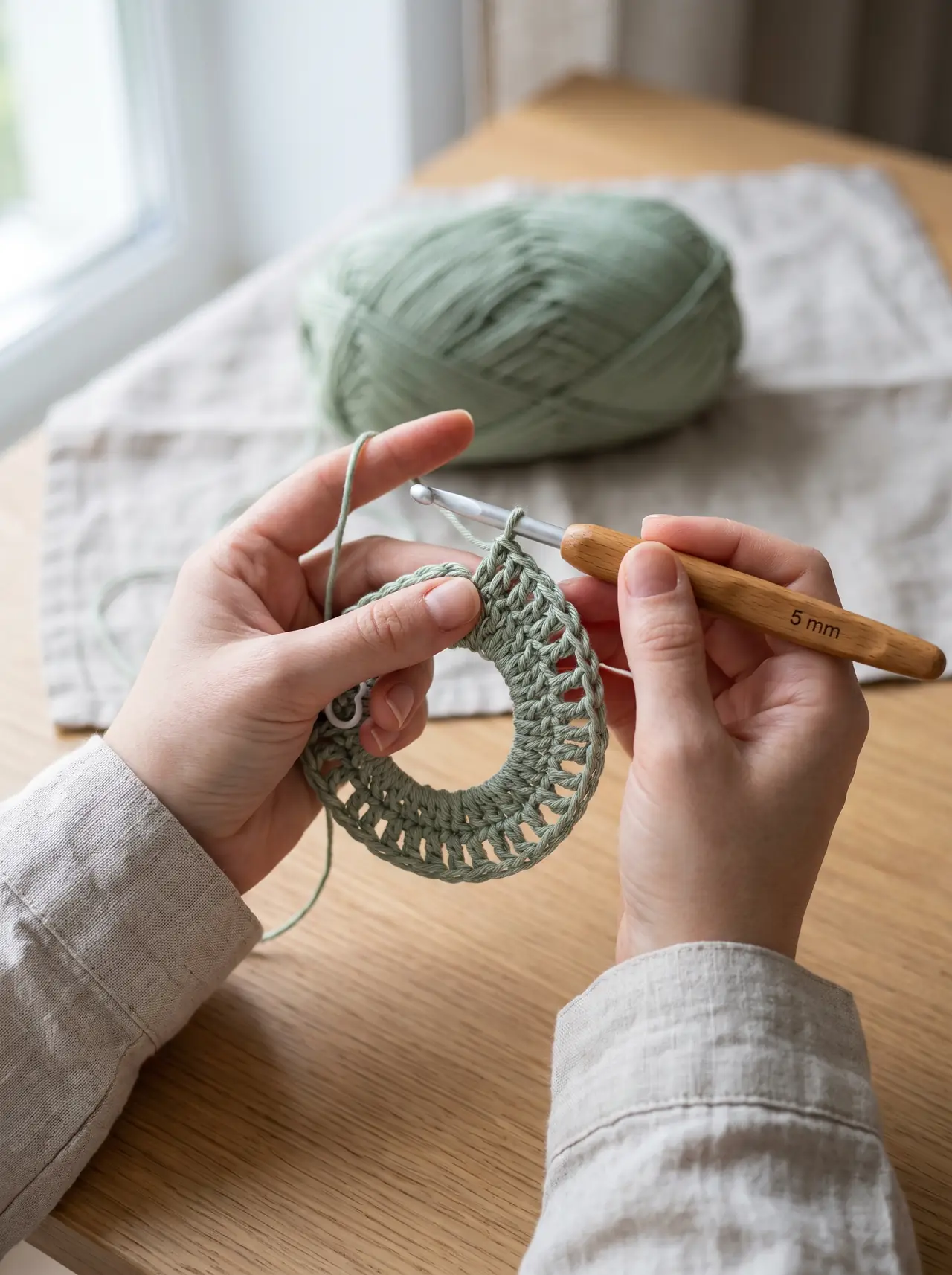
Chain 64 and lay the chain flat on the table. Run your finger along it to check it is not twisted, then join it into a ring with a slip stitch in the first chain. A twisted ring turns the finished tube into a spiral, and the bag will never sit flat.
Round 1: chain 1, then work 1 single crochet in each chain around, which gives 64 stitches, and join with a slip stitch to the first single crochet. Round 2: chain 1 and single crochet in each stitch around, 64 stitches, then join. These two solid rounds form the firm border along the bottom of the bag.
Clip the stitch marker into the first stitch of the round and move it up at the start of each new round. The ring is where your bag begins to take shape, so it is worth learning the join well, as it is one of the skills in our crochet wearables guides for shaped, stitched-in-the-round projects.

From our shop
Wildflower Bandana
A light triangle headscarf in cotton with rows of open flower motifs, long ties and a scalloped picot border. PDF pattern in US terms.
Get the pattern for $0.99 →Digital download. Nothing is shipped.
Step 3: Work the Double Crochet Mesh Rounds
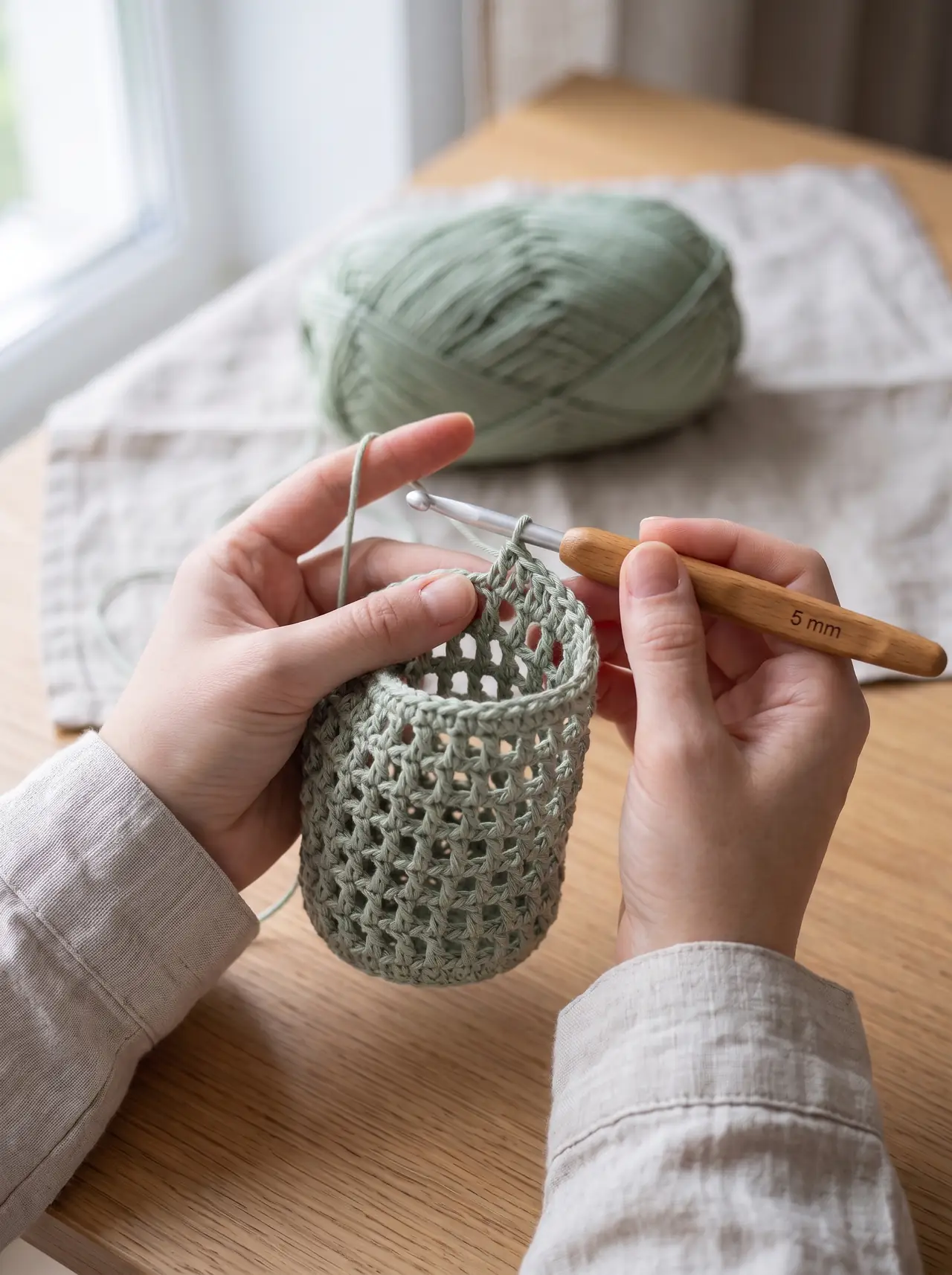
Round 3: chain 4 (counts as a double crochet and a chain 1 space). Skip the stitch you stand in and the next single crochet. *Double crochet in the next single crochet, chain 1, skip the next single crochet.* Repeat from * 31 times.
Join to the third chain of the chain 4. You now have 32 double crochets and 32 spaces, and the mesh is under way.
Rounds 4 to 22: chain 4, which counts as a double crochet and a chain 1 space. *Double crochet in the next double crochet, chain 1.* Repeat from * 31 times, then join to the third chain of the chain 4. Every double crochet lands on the one below, which keeps the holes square, and the 20 mesh rounds are now complete.
Do not stitch into the chain 1 spaces; they are the holes, and you simply move past them to the next double crochet. Count your double crochets every five rounds. The count should always be 32, and the tube should show 16 holes across when it lies flat.
Sara's Studio Observation: Keep the working yarn under even tension and pull each chain 1 to the same length as the last. Holes that vary by a millimeter become very visible once the bag is loaded with groceries.
Step 4: Check the Tube Before You Seam the Base
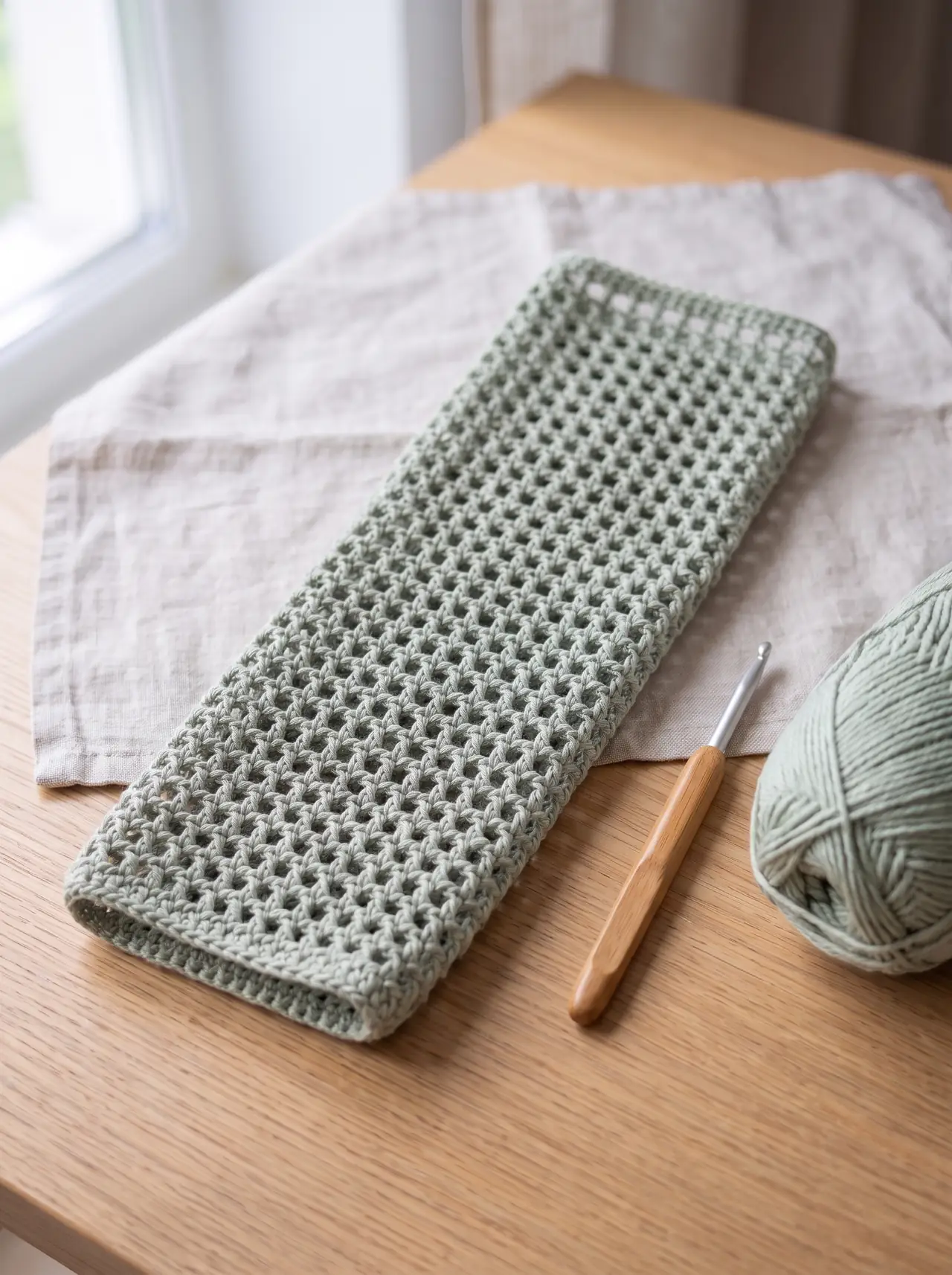
Work the five rim rounds first if you like, then lay the tube flat on a table. A standard tube is about 9 inches wide when flat, though tension changes the numbers. If it is much narrower, your hook was small; if it is much wider, the mesh is loose and will stretch further under load.
Mist the tube with water, pull it gently to square up the holes, and let it dry flat. Blocking is optional for a casual bag, but it evens out round-to-round differences and makes the base seam much easier to line up.
If you find a mistake, unravel to the round before it. The mesh rips back easily, and fixing a short section is faster than living with a bag that tilts.
Step 5: Seam the Bottom with Single Crochet
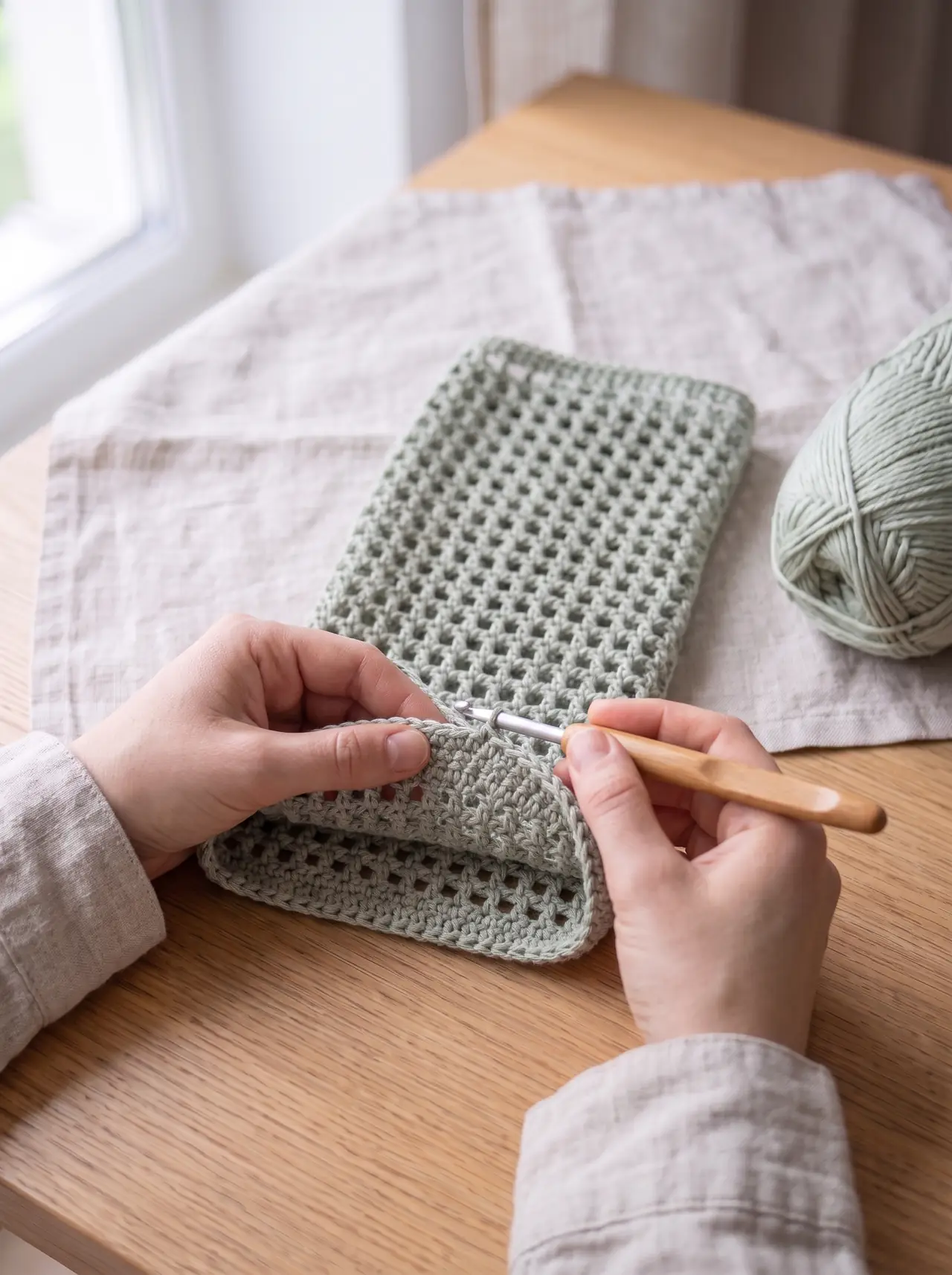
Fold the tube flat with the foundation chain edge toward you and the join line along one fold. Line up the chains of the two layers so they match one for one, and mark the first pair with your stitch marker or a scrap of yarn.
Join the yarn at one corner through both layers of the remaining loops of the foundation chain, chain 1, and work 1 single crochet through both layers in each pair of chains across. That is 32 single crochets in all, since 64 chains fold into 32 pairs.
Fasten off and weave in the ends along the seam. The two solid rounds and this seam make the base the firmest part of the bag, right where the weight of the shopping rests.
Step 6: Add Five Rim Rounds in Single Crochet

Join the yarn at a side fold of the top edge. Round 23: chain 1, then work 1 single crochet in each double crochet and 1 single crochet in each chain 1 space around, 64 stitches in all, and join with a slip stitch to the first single crochet.
Rounds 24 to 27: chain 1 and single crochet in each stitch, 64 in all, joining each round with a slip stitch. Fasten off after Round 27. That gives a solid band of five rounds around the top of the bag.
The solid rim does two jobs. It stops the open mesh from stretching out of shape at the opening, and it gives the straps something firm to be sewn to. Keep your single crochets slightly loose, because a tight rim pulls the opening smaller than the bag body.

From our shop
Nordic Star Ornament
A six-point star in lightweight cotton or wool with raised front-post ridges along every point. PDF pattern in US terms with step-by-step photos.
Get the pattern for $0.99 →Digital download. Nothing is shipped.
Step 7: Make and Sew the Straps
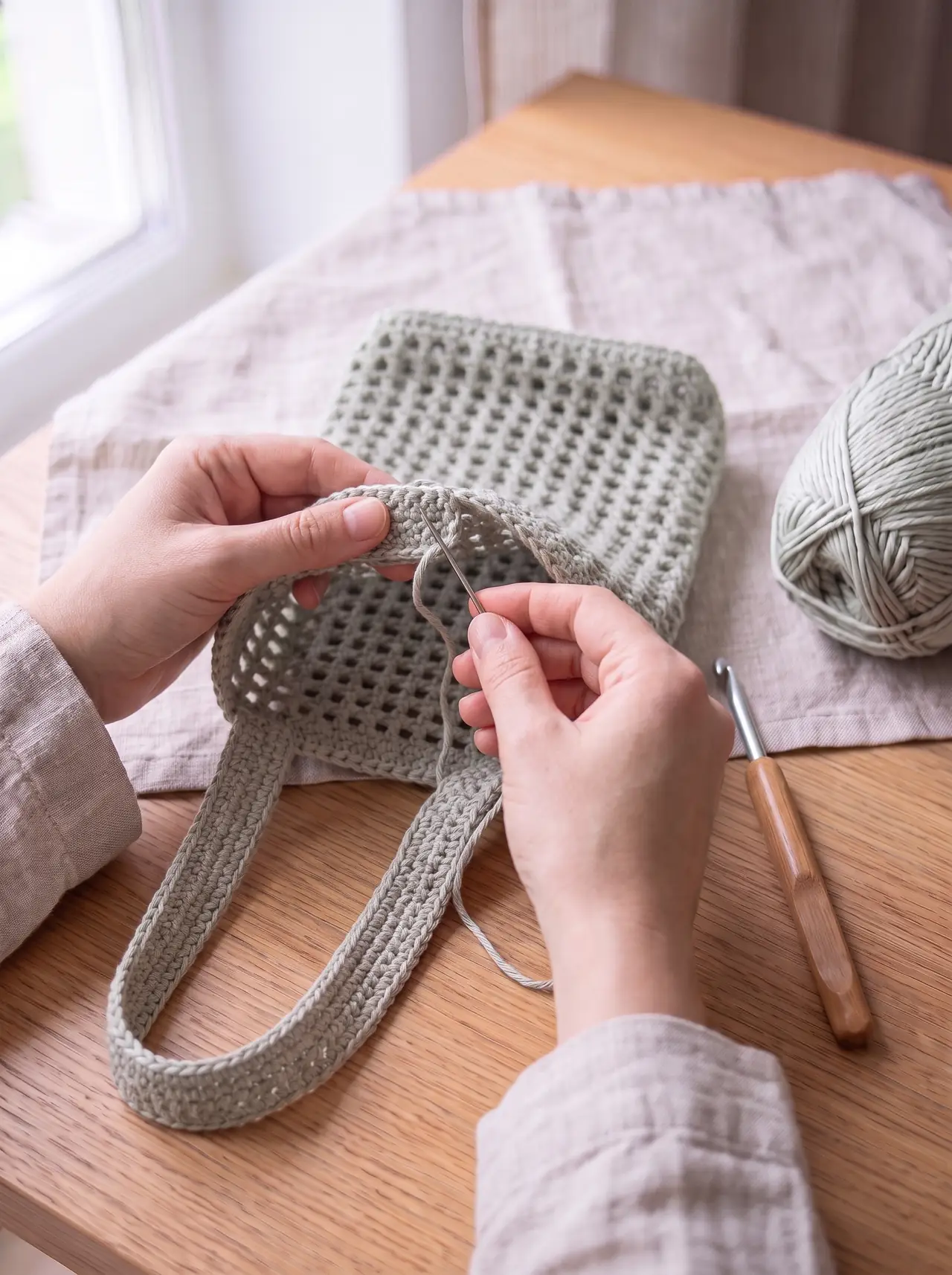
Make two straps. Chain 111. Row 1: single crochet in the second chain from the hook and in each chain across, 110 stitches. Rows 2 to 5: chain 1, turn, and single crochet in each stitch across. Fasten off, leaving a 12 inch tail at each end for sewing. Each strap is about 31 inches long and 1.25 inches wide.
Count the 32 rim stitches of the front layer from the left fold. Pin the first strap end over stitches 4 to 9 and the second end over stitches 24 to 29, so the ends sit 14 stitches apart. Repeat on the back layer so both straps match and hang evenly.
Sew each end with the tail, taking small stitches through the rim and through the last rows of the mesh below it. Keep the strap flat and untwisted as you sew. Once all four ends are in, hang the bag by the straps and check that they sit level.
Step 8: Finish Your Crochet Market Bag Pattern and Check the Drape

Weave in all remaining ends along the rim or into the straps, then trim them. Hang the finished bag by the straps from a peg or a door handle and look at it from the front. The rim should hang in an even line, and the mesh should show about 16 square holes across.
If one strap sits lower than the other, unpick the end that sits low and resew it a few stitches higher. A strap that is off by even one round makes the bag lean sideways when you carry it.
You can wash and block the bag once now to set the stitches. After it dries, the mesh settles into its final shape, and the bag is ready for a first trip to the farmers' market.
Step 9: Load Test Your Market Tote Before You Trust It

Fill the finished tote bag with about 5 pounds of groceries, hang it by the straps from a sturdy hook, and leave it overnight. Measure how much the bag has lengthened. A few inches of stretch is normal for mesh and the bag will spring back, but a very long bag or a sagging base means the mesh is too loose.
If the bag stretches too much, make the next one with a hook half a millimeter smaller, or add two rounds of single crochet in the middle of the mesh. Those solid rounds act like a belt, and they also give you a firm line to fold when the bag is empty.
Test again after the first wash, because cotton can relax a little. A baguette, leafy greens and a few oranges sit comfortably in a reinforced cotton mesh bag, but heavy items such as cans and bottles belong in a sturdier tote.

From our shop
Mini Holiday Green Monster
A small, cheeky green plushie worked from the toes up, with an embroidered smirk, a curly hair tuft and a striped scarf. PDF pattern in US terms.
Get the pattern for $0.99 →Digital download. Nothing is shipped.
Step 10: Reinforce the Strap Joins After the Test

The strap joins are where a crochet tote fails, because the whole load hangs from a few stitches. Sew around the 6 by 3 block twice with the long tail, then stitch an X across the box from corner to corner. The X spreads the pull across the rim instead of a single row.
Use the strap tail or a strong cotton thread, not a thin sewing thread, which can cut through the mesh. Knot the ends inside the rim and tuck the tails into the strap so that nothing hangs loose or catches in your sleeve.
Pull test every joint. Hold the bag by one strap and tug firmly, then do the other three joints. If you feel any give, add a second X. A reinforced join is the difference between a bag that lasts for years and one that drops oranges in the car park.
If you would rather build a patchwork tote, our crochet granny square bag ideas show ten ways to do it, from slouchy shoulder bags to small clutches.
Resize Your Mesh Market Bag
Resizing is simple because the mesh is built from pairs of chains. Each extra 2 chains in the foundation ring adds one more double crochet and chain 1 repeat, which widens the flat bag by about a quarter inch, and each extra mesh round makes it roughly half an inch taller.
Keep the foundation chain an even number so the repeat closes cleanly at the join. For the large size, chain 96 and work 26 mesh rounds, and for the extra large beach version, chain 128 and work 32. The seam then has 48 or 64 stitches, and each rim round has 96 or 128.
Straps should grow with the bag. For the large and extra large sizes, make the straps with 130 stitches, and keep the width at five rows. Place the strap ends about one sixth of the rim width in from each fold, so the handles stand upright the way they do on the standard bag.
Fix Sagging, Twisting and Uneven Holes
The base sags. The mesh is too loose, or the bag is loaded beyond its limit. Next time use a hook half a millimeter smaller, and add two rounds of single crochet just above the base seam. A solid band at the bottom keeps the weight from pulling the lowest holes into long ovals.
The tube twists like a spiral. The foundation chain was twisted when you joined the ring. There is no clean fix, so unpick the join and start again. Always lay the chain flat and run your finger along it before you slip stitch, and mark the first chain with a stitch marker.
The holes look uneven. Double crochets of different heights or chain 1 spaces of different lengths cause this. Slow down on the first round after a break, and keep each chain 1 at the same length. A light blocking session evens out most small differences.
The rim flares outward. The rim rounds are too loose, or there are extra stitches in the first rim round. Count to 64 on Round 23, and use a hook half a millimeter smaller on the rim rounds than on the mesh. A snug rim keeps the opening at a stable width.
Wash, Dry and Line Your Cotton Market Bag
A mesh crochet bag is easy to care for in cotton. Wash the bag by hand in cool water with a mild soap, or place it inside a laundry bag and use a gentle machine cycle. Reshape it while damp, pull the holes square and dry it flat or hang it by the straps in the shade.
Avoid hot dryers, which can shrink cotton and make the mesh stiff, and avoid bleach, which weakens the fibers at the strap joins. If the bag has carried produce, rinse it before drying, because fruit juice leaves sticky spots that attract dust.
If you want to carry small items such as mushrooms, herbs or loose snacks, sew a simple lining from lightweight cotton fabric. Cut a rectangle the size of the flat bag, sew the sides, and stitch the top of the lining to the inside of the rim. A lining reduces the stretch, so use it only when you need it.
Frequently Asked Questions
How much yarn do I need for a crochet market bag?
The standard bag takes about 240 yards of worsted weight cotton yarn, which is two balls of about 125 yards each. The large size needs about 380 yards and the extra large about 570 yards. Buy one extra ball if you want longer straps.
What is the best yarn for a mesh market bag?
Mercerized cotton is the best choice because it is strong, smooth and holds its shape when wet. Plain cotton also works, but it fuzzes sooner. Acrylic is not recommended for a market bag, because it stretches more and does not recover as well under load.
How much weight can a crochet market bag hold?
It depends on your yarn, your hook and how well the strap joins are sewn. Run the load test in this crochet market bag pattern: fill the bag with 5 pounds, hang it overnight and measure the stretch. Light groceries such as bread, fruit and greens suit a mesh bag well.
How do I make the bag bigger or smaller?
Change the foundation chain in steps of 2 and the number of mesh rounds. Each extra 2 chains adds about a quarter inch to the flat width, and each extra round adds about half an inch to the height. Adjust the strap length to match the new size.
This crochet market bag pattern gives you a reusable, washable crochet tote bag that suits the farmers' market, the beach and the daily errand run. Once you know the rhythm of double crochet and chain 1, you can change the size, the color or the strap length, and make a set of bags for friends in an evening or two.
Save This for Later
Pin this guide to your crochet board so it is ready when you start your next project.
Save on Pinterest