
The best crochet coaster patterns are small cotton circles, 10 to 11 cm across, worked from a magic ring so they lie flat and soak up condensation. Daisies, sunflowers, clovers and ginkgo fans all suit that size, and each takes under an hour with worsted weight cotton yarn and a 4 mm hook.
A coaster has one plain job: it keeps a cold glass from leaving a pale ring on a wooden table. Botanical motifs turn that job into a small garden at every seat, and a set of four or six is a gift that looks far more expensive than the little yarn inside it.
Most roundups stop at the flower. The eight patterns below go further, with a clover, a ginkgo fan and a lavender stripe, and they come with the practical notes that decide whether a coaster lasts: fiber, size, colorfastness and what to do when the edges curl.
Every pattern names the yarn, the hook and the one detail that makes it look finished, so you can work straight from this page. Make one flower coaster first, test it against your own mug, then repeat it in a set.
Table of Contents 16 sections
Crochet Coaster Patterns at a Glance
Pick by flower, by stitch and by how much time you have.
| Coaster | Shape | Key Technique | Skill | Time |
|---|---|---|---|---|
| Daisy | Round | Evenly spaced petals | Beginner | 40 min |
| Sunflower | Round | Popcorn seed center | Easy | 1 hour |
| Clover | Trefoil | Three spiral discs | Beginner | 45 min |
| Lavender stripes | Square | Puff stitch rows | Easy | 1 hour |
| Poppy | Round | Overlapping petals | Intermediate | 1 hour |
| Ginkgo fan | Fan | Scalloped fan rows | Easy | 50 min |
| Succulent rosette | Round | Layered leaves | Intermediate | 1.5 hours |
| Rose spiral | Round | Stacked raised rings | Intermediate | 1.25 hours |
1. A Cream Daisy With a Mustard Center
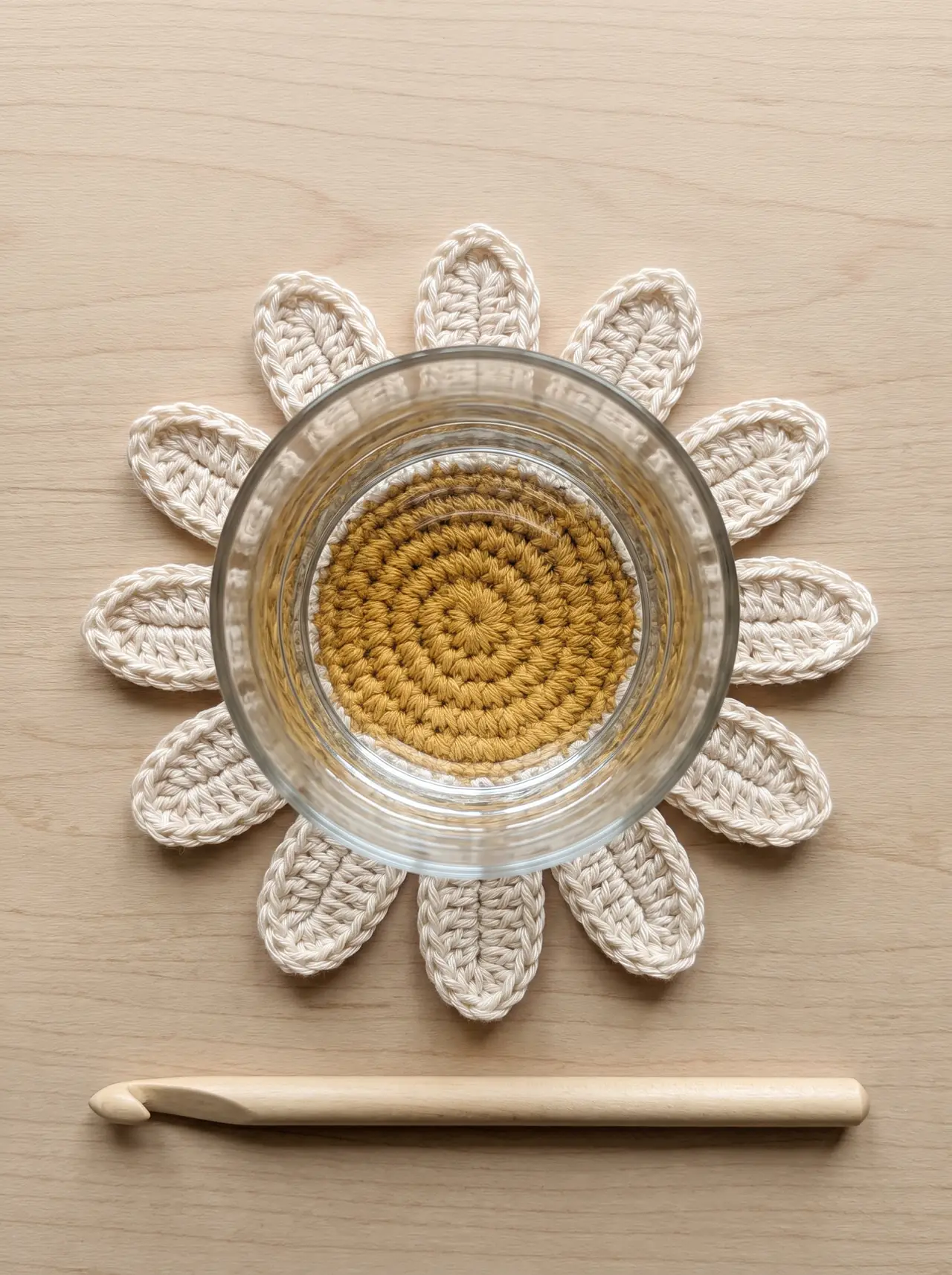
Start with the center so the petals have something to hang from. Work 12 single crochet in a magic ring in mustard, pull it tight, then increase to 24 stitches in the second round. Those 24 stitches give you a flat disc about 4 cm across, the right size for a daisy that ends at 10 cm.
Switch to cream and work 12 petals, one into every second stitch. Each petal is a slim oval worked around a chain: chain 5, then single crochet, half double crochet and 2 double crochet up one side, 3 double crochet in the last chain, and the mirror back down the other side. Slip stitch into the next stitch.
A petal count that divides evenly into the center keeps the flower balanced, while an odd number bunches up on one side. If your petals fold over, you have pulled the chain too tight, so let it sit loose and the petal opens by itself.
2. A Sunflower With a Textured Seed Center
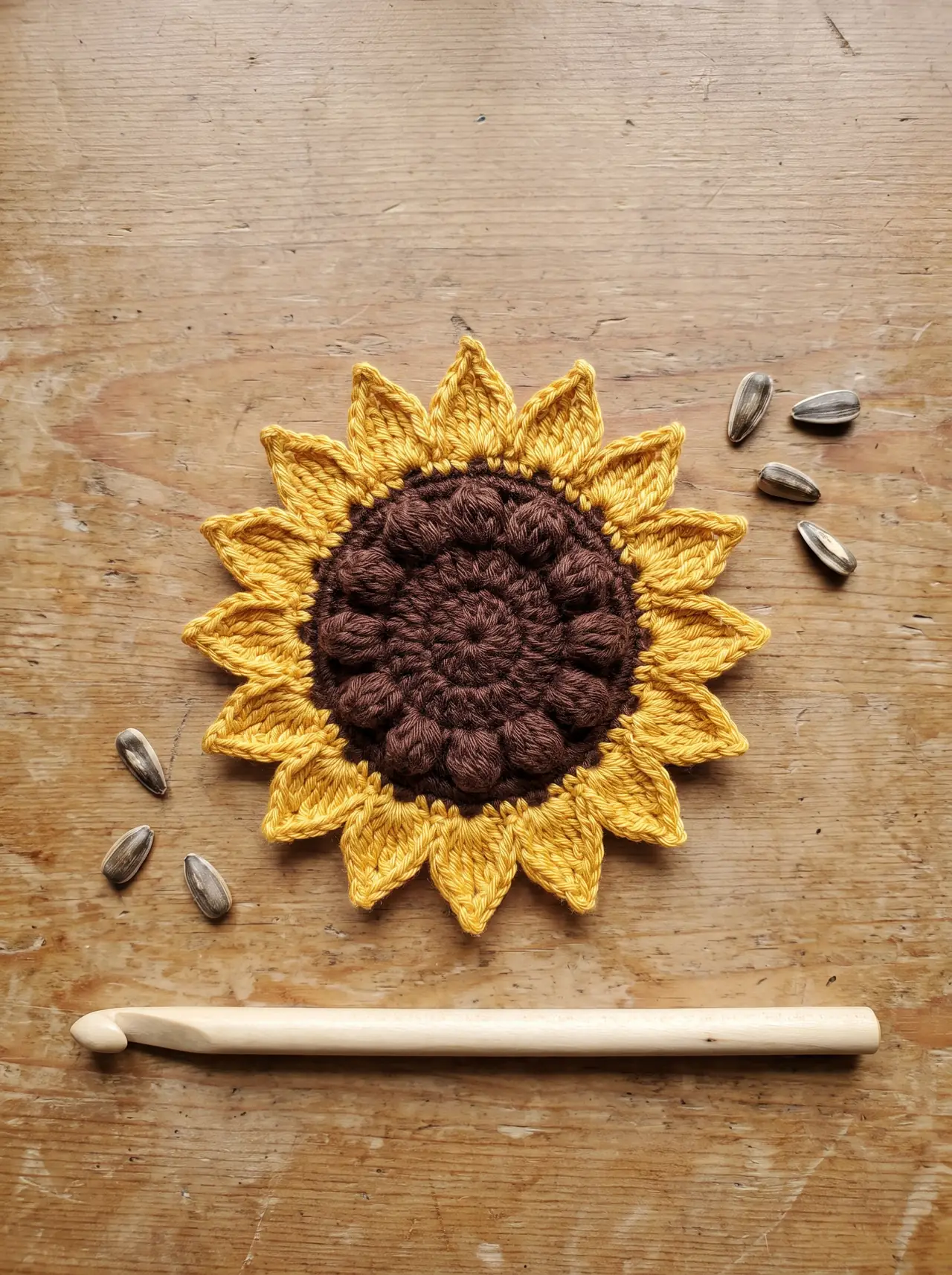
The seed head is what makes a sunflower read as a sunflower, and a ring of popcorn stitches builds it in one round.
Work the brown disc to 24 stitches, then make a popcorn in every other stitch: five double crochet in one stitch, remove the hook, insert it in the first double crochet and pull the dropped loop through. That gives a ring of 12 bobbles around the middle.
Work one more brown round, increasing to 32 stitches, then join yellow for the petals and make each one pointed, not round. Chain 4, work single crochet, half double crochet and double crochet back along the chain, and slip stitch into every second stitch, which gives 16 petals.
A cup sits securely on the textured center because the bumps are low and the petals lie flat around them. For a richer look, work a second round of petals in a deeper gold behind the first and let the points peek out between them.

From our shop
Mini Holiday Green Monster
A small, cheeky green plushie worked from the toes up, with an embroidered smirk, a curly hair tuft and a striped scarf. PDF pattern in US terms.
Get the pattern for $0.99 →Digital download. Nothing is shipped.
3. A Three-Lobed Clover
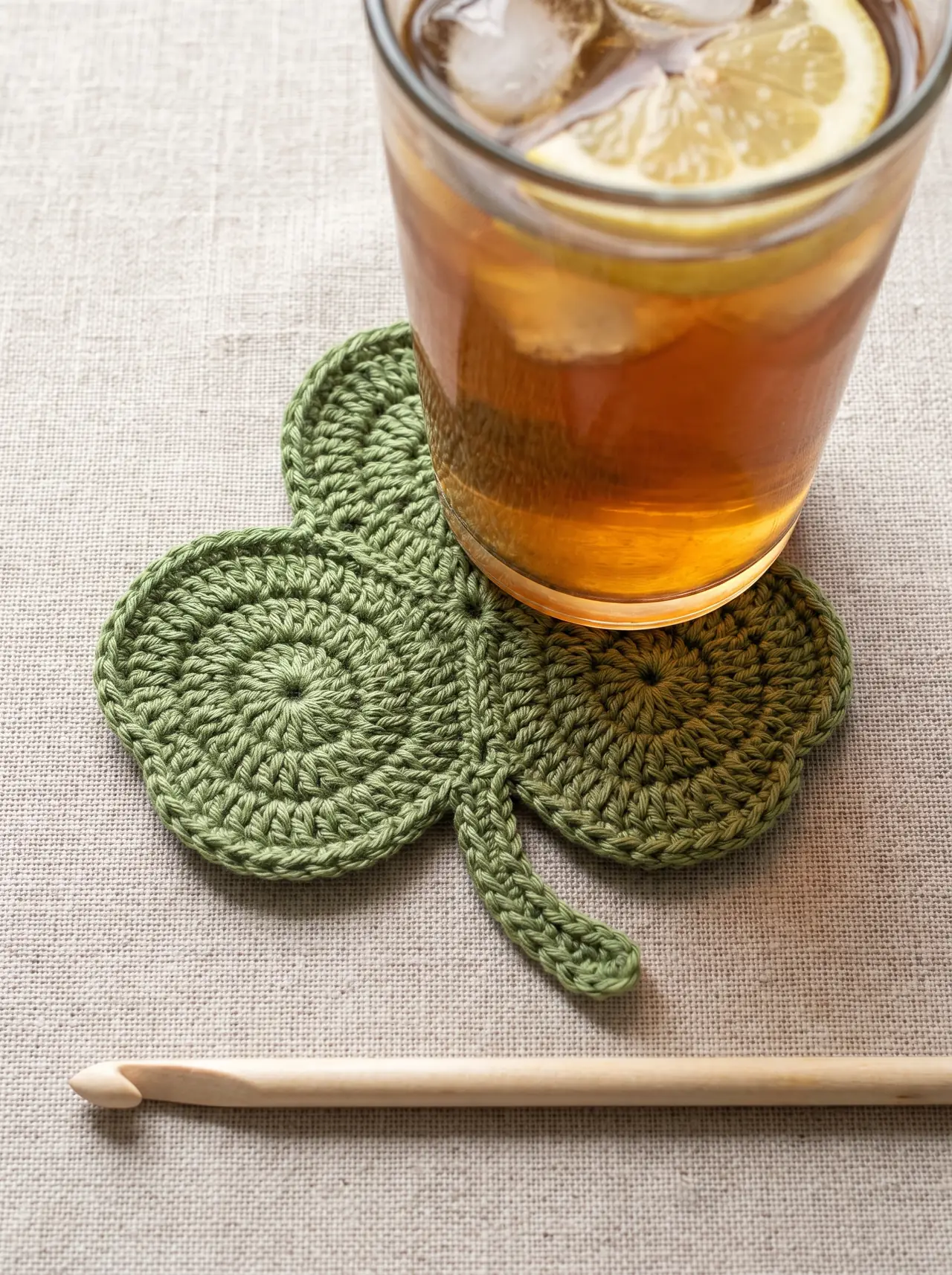
Green coasters hide spills better than any other color, which makes them the practical choice for a busy kitchen table. A clover is the simplest green motif for crochet home decor: three round discs joined at one point, then a curved stem. It needs no color changes and no shaping beyond the increases of each disc.
Make three discs, each worked in a spiral of single crochet from a magic ring: 6 stitches, then 12, 18 and 24. Each disc lies flat and is about 5 cm across. Fasten off the first two with a long tail and keep the third on the hook.
Set the three discs in a triangle so they touch at one point and join them there with a few slip stitches. Work one round of single crochet along the outer edge so the joins blend in and the edge feels firm.
Chain 8 from the join and slip stitch back along it for a stem that curves down and gives the coaster a clear top and bottom. For a four-leaf version, make a fourth disc and set the four in a cross, and keep that one as a gift for luck.
4. A Lavender Stripe Square
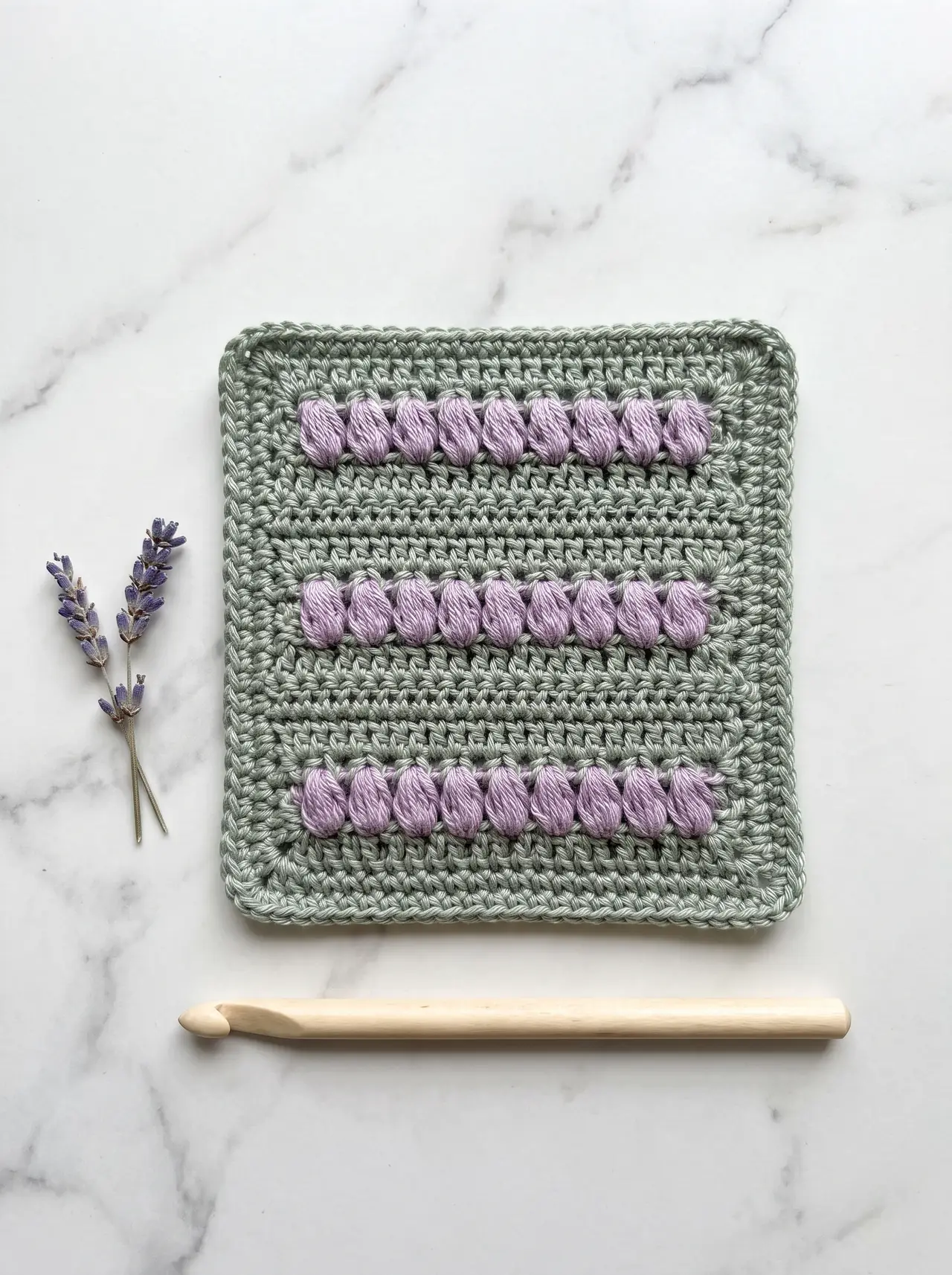
Lavender is a flower you can suggest with texture alone. Chain 15 in sage, then work half double crochet in the third chain from the hook and in each chain across, which gives 13 stitches. Work a second sage row, then the first puff row: 2 hdc in sage, 9 puffs in lavender, and 2 hdc in sage.
A puff is three half double crochet pulled up in the same stitch and closed together. The raised puffs read as tiny flower spikes in neat lines, and 3 plain sage rows between the puff rows give the eye a rest. A square is also the quickest shape to finish because you work back and forth and never count increases.
Make 13 rows in all: 2 sage rows, a puff row, 3 sage rows, a puff row, 3 sage rows, a puff row and 2 sage rows. Then work one round of single crochet around the edge with three stitches in each corner, which frames the puffs with a sage border. Add plain rows for a larger square.
5. A Red Poppy With Overlapping Petals
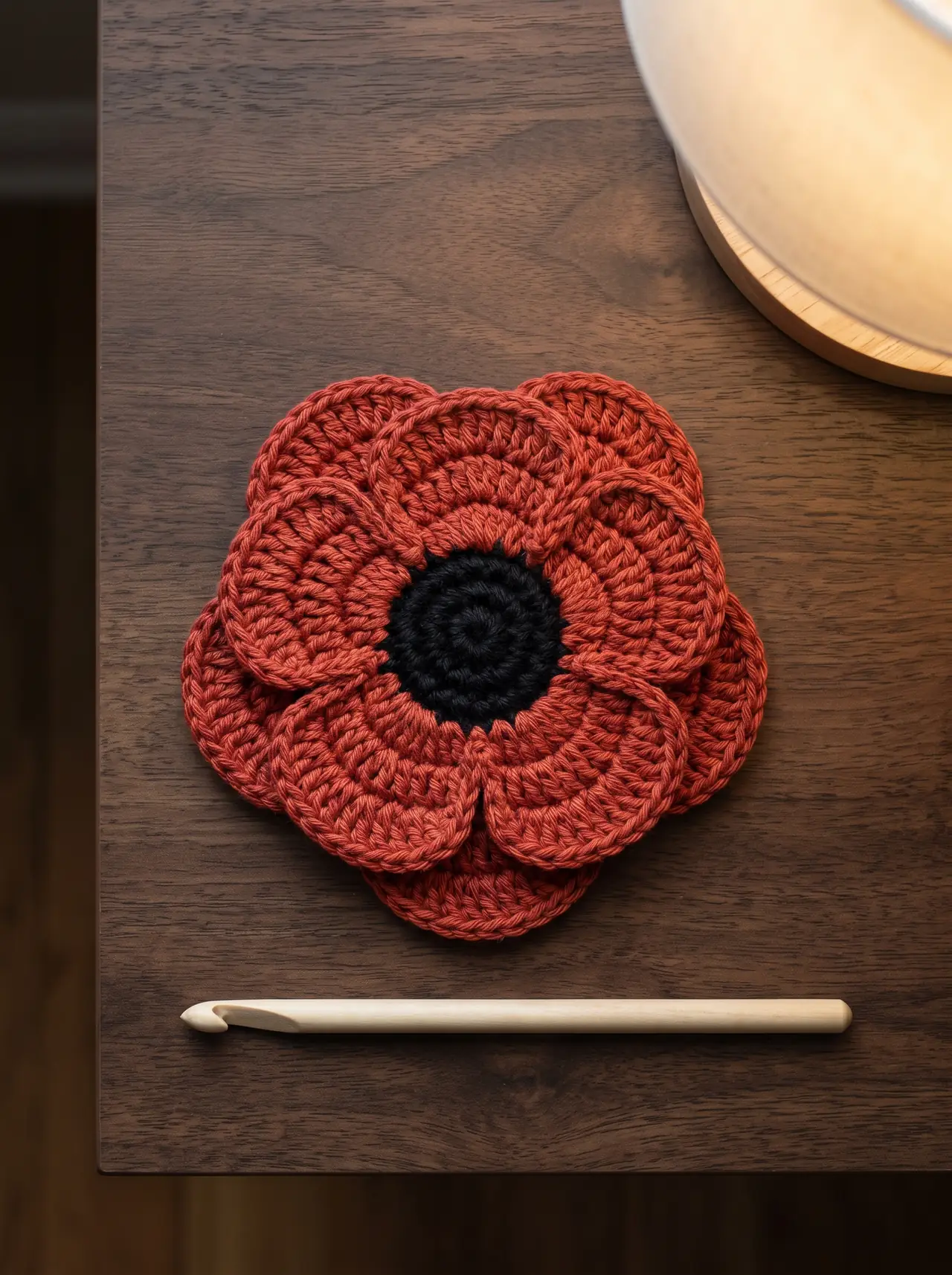
A poppy has papery petals that overlap, and you can copy that with two layers. Work a black center of 12 single crochet in a magic ring, then join red and build five petals around it, each a small fan of 7 double crochet worked into one stitch. Slip stitch between the fans so each petal stands slightly apart.
Add a second layer behind the first by working into the front loops you left unworked in the black round. Offset these five petals so they fall in the gaps, and the flower looks full from every angle.
Finish with a round of single crochet in red to bind the layers into one thick, absorbent coaster. Of all the designs here, this one benefits most from a damp block, because overlapping petals pull the edge out of shape until they are pinned.
6. A Ginkgo Fan in Butter Yellow
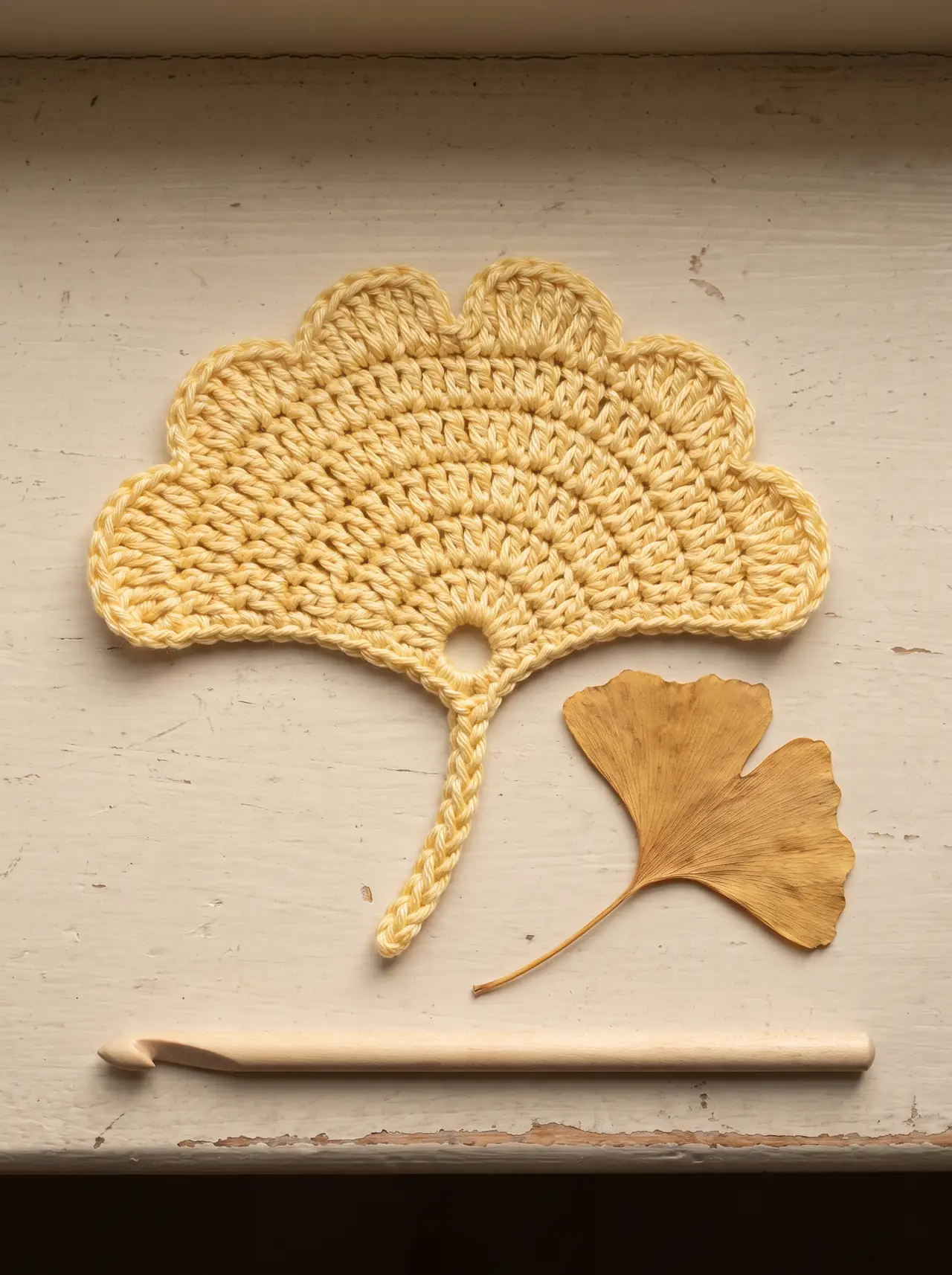
The ginkgo is the one tree whose leaf is a fan, so a fan stitch is exactly the right tool. Chain 4 and join into a ring, then work 15 double crochet into it, turn, and increase with two double crochet in every stitch to reach 30.
A third row alternates one and two double crochet in each stitch, giving about 45 stitches and a smooth curve.
Finish with a scalloped edge of small shells so the top rolls into three soft lobes, and edge the base with single crochet. The ring from the first round stays open as a small hole, and a 5 cm chain stem hangs below it.
Butter yellow looks best in autumn, and a pale green works through the summer. Because the shape is a fan, the coaster tucks neatly beside a plate and is useful on a crowded side table where a full circle would not fit.

From our shop
Botanical Lace Flower Bookmarks
Three lace flower bookmark designs in two colorways each, worked in thread with a steel hook. PDF pattern in US terms with photos and charts.
Get the pattern for $0.99 →Digital download. Nothing is shipped.
7. A Succulent Rosette in Two Greens
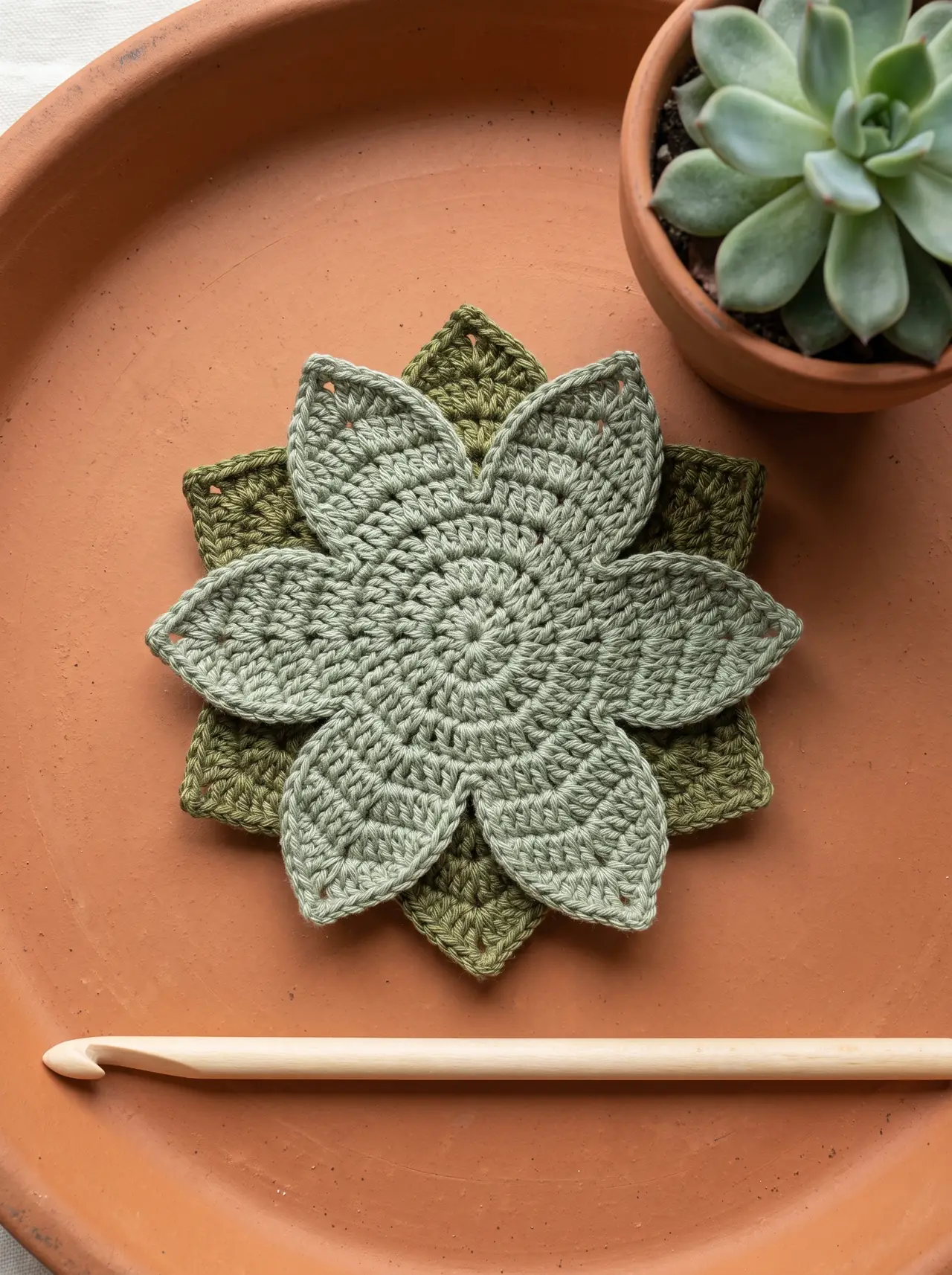
A succulent is a spiral of pointed leaves, and you can build it as two simple layers. Work a base disc of 18 single crochet in sage, increasing evenly each round, and fasten off the first layer by working only into the back loops of the last round. The leftover front loops hold your second layer.
Make each leaf as a short chain-and-slip-stitch oval: chain 5, slip stitch in the second chain, then single crochet, half double crochet and single crochet back to the base. Six leaves go on the front layer in sage.
Join moss to the unworked loops and offset six more leaves behind. Cotton keeps the points crisp where acrylic would fray, and the two greens give the rosette depth without any shaping at all.
8. A Rose Spiral With Stacked Raised Rings
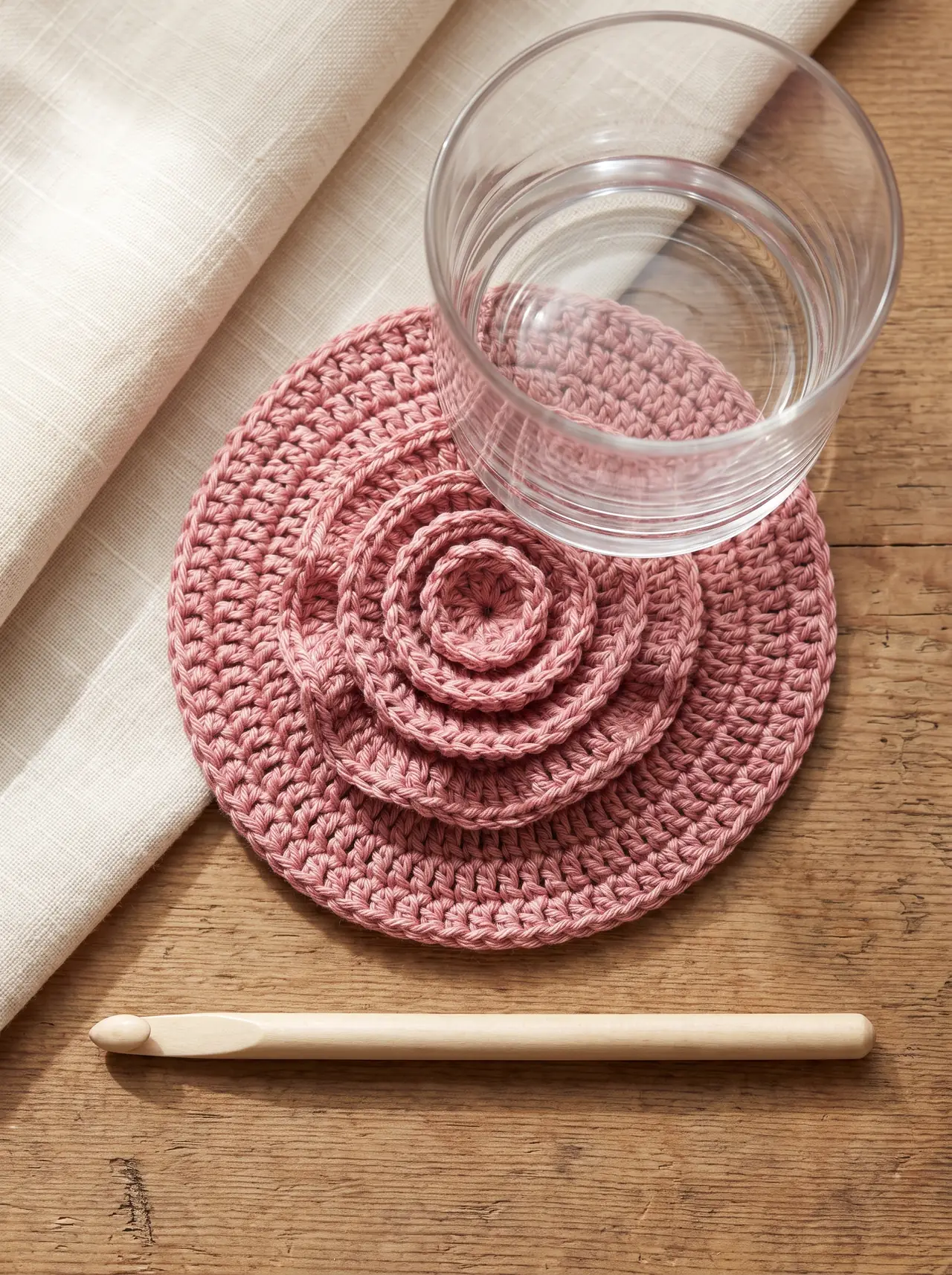
A rose coaster has two parts: a flat base and a stack of rings that spirals into the flower. Make the base first as a disc of 36 single crochet worked in a spiral, so it is firm and level.
Then make three smaller discs in the same way, of 24, 16 and 8 stitches, working the last round of each in the back loops only so the rim stands up as a raised ring. Stack them from largest to smallest, off center, so the rings step up toward the middle like rose petals.
Sew each ring to the layer below from underneath with a tapestry needle and leave the outer rim a little loose for softness. Because the center stands up slightly, keep this one for cold bottles and not for tall wobbly glasses. It pairs well with the autumn table in our crochet pumpkin pattern.
Why Cotton Yarn Beats Everything Else for Coasters
Fiber decides how a coaster behaves more than any pattern does. Cotton absorbs condensation, tolerates a warm wash, and has no stretch, so the edges do not sag after a month of use.
Mercerized cotton adds a slight sheen and stronger color, and it stays crisp at the edges, which is why it suits petals and points. If a label says mercerized, it has been treated to take dye more deeply, and your reds and golds will wash less pale.
Acrylic repels water, so a cold glass leaves a pool that slides off the coaster and onto the table. Linen and hemp also work well and soften beautifully with washing, though they start stiff and can be rough on the hands. Wool felts when washed, so keep it for decorative mats and not coasters.
A coaster is not a trivet, and the difference matters. Cotton insulates against a warm mug but not against a hot pan from the stove, which can scorch the fibers. For hot dishes, make a thicker mat in the same pattern with two strands of yarn held together.

From our shop
Nordic Star Ornament
A six-point star in lightweight cotton or wool with raised front-post ridges along every point. PDF pattern in US terms with step-by-step photos.
Get the pattern for $0.99 →Digital download. Nothing is shipped.
How to Size a Crochet Coaster
Choose worsted weight for the patterns above, with a 4 mm hook rather than the 5 mm on the label. A smaller hook makes a dense fabric that absorbs well and hides the table through the stitches.
The usual size is 10 to 11 cm, about 4 inches, but the rule that matters is relative: a coaster should be at least 2 cm wider than the base of your widest mug. Measure the base, add 2 cm on each side, and you have your diameter.
If the finished circle is too small, add one round of single crochet in the main color rather than starting again. Each extra round adds about 1 cm to the width. If it is too large, work fewer petal rounds, because the petals carry most of the diameter.
Make a swatch before a whole set. Crochet one coaster, wet it, let it dry flat and measure again, since cotton relaxes and can grow or shrink by a few millimeters. That single test saves you from a set of four that does not match.
The Petal Count Rule and the Invisible Join
Petals look balanced when their number divides evenly into the stitches beneath them. Twelve petals on 24 stitches, or sixteen on 32, sit perfectly, while eleven petals on 24 stitches leave one gap that the eye finds at once.
Before you start a petal round, divide the stitch count by the petal number and mark each starting point with a stitch marker, so the spacing stays even all the way around.
The second small detail is the join. Instead of slip stitching into the first stitch, which leaves a visible bump, make your last stitch, cut the yarn and pull the tail through. Thread it on a tapestry needle and weave it under the top two loops of the first stitch to form a neat chain.
An invisible join takes thirty seconds and makes the coaster look machine finished from above. Weave each tail in two directions, then trim it close with sharp scissors, because loose ends catch on glasses and pull the stitches.
Block, Stiffen and Test Your Colors
Blocking turns a good coaster into a flat one. Pin it out damp on a towel, or lay it under a heavy book overnight, and the petals settle into place and the edges stop curling. Cotton holds the shape once dry.
For flowers that flop, stiffen them lightly. Mix two parts water with one part fabric starch, dip the coaster, press out the excess in a towel and dry it flat. Starch also resists stains slightly, which helps a coaster that sits under a sweating glass all evening.
Test any dark or bright yarn before you stitch with it. Soak a short length in warm water on a white towel for ten minutes, and if the towel shows color, wash the skein before you use it. Reds, deep greens and purples run most often, and a bleeding coaster can mark a pale tabletop permanently.
What Fails First on a Crochet Coaster
Coasters live on wet, warm surfaces, so they show faults quickly. Here is what goes wrong, and the fix for each.
- If the edges curl up into a saucer, your tension is too tight. Go up half a hook size, or block the coaster flat under a damp towel and a heavy book for a day.
- If the colors run in the wash, the dye was never set. Run the soak test on every dark yarn, and wash the finished coaster cool with a color catcher.
- If the coaster smells musty, it was stored damp. Dry it flat in the open air, because mildew grows in the folds of a wet stack.
- If a flower flops over, it needs body. Dip it in a mix of two parts water to one part fabric starch, press it flat and let it dry.
- If the petals bunch on one side, the count does not divide into the center. Use a petal number that is a multiple of the center stitches.
- If a join shows as a bump, fasten off and weave the tail through the first stitch, and your seam will sit flat.
Frequently Asked Questions
What is the best yarn for crochet coasters?
Mercerized worsted weight cotton is the best yarn for coasters. It absorbs condensation, holds a crisp shape and survives a warm wash. Avoid acrylic, because it repels water and lets a cold glass leave a ring on your table.
What size should a crochet coaster be?
A crochet coaster should be 10 to 11 cm across, about 4 inches. That is wide enough to catch the drip from a mug, and small enough to fit four on a tray. Make it 12 cm if you often use wide tumblers.
How do you keep a crochet coaster from curling?
Use a hook half a size larger on the last two rounds and block the finished coaster flat. Pin it out damp, or press it under a heavy book overnight. Edges that curl are almost always a sign of tight tension.
Can you machine wash crochet coasters?
Yes, if they are cotton. Wash them cool on a gentle cycle in a mesh bag and dry them flat. Test dark colors for bleeding first, and avoid hot water, which can shrink cotton by a few millimeters.
Which Coaster to Make First
Start with the daisy or the clover if you have an hour, because both use only basic stitches and forgive uneven tension. Save the poppy, the succulent and the rose for a weekend, when layered petals feel relaxing and not fiddly.
Once your first set of four is done, you will see how little yarn it takes. Keep these crochet coaster patterns nearby, and every housewarming and birthday on your calendar already has a gift in it.
Save This for Later
Pin this guide to your crochet board so it is ready when you start your next project.
Save on Pinterest