Finding a quality crochet maple leaf pattern free of complicated joining hurdles allows you to turn seasonal cotton scrap yarn into breathtaking dining table runners, rustic mug rugs, scalloped placemat borders, and glowing candle wreaths in just an afternoon.
Autumn dining tables call for tactile textures that feel grounded, welcoming, and handmade. While store-bought fall decorations often rely on synthetic plastics or stiff polyester prints, handcrafted crochet accessories bring organic weight, rich color variation, and true maker spirit into your dining space.
Working with botanical foliage motifs allows you to celebrate natural seasonal shifts right from your yarn basket. With just a single skein of worsted weight cotton or leftover wool remnants, you can produce durable table accents that safeguard wood surfaces from steaming ceramic mugs and hot serving dishes.
Whether you need quick forty-minute mug rugs for morning coffee or an elaborate interlocking runner for Thanksgiving dinner, this curated collection covers ten versatile projects. Every design highlights functional table styling, clear gauge parameters, and step-by-step assembly notes directly from my studio workbench.
Quick-Scan Autumn Table Decor Pattern Guide
Review the materials, finished dimensions, and practical dining applications for all ten autumn leaf designs before choosing your first hook and yarn combination.
| Project Name | Primary Table Use | Recommended Yarn | Hook Size | Skill Level |
|---|---|---|---|---|
| Two-Tone Mug Rug | Morning coffee mug coaster | Worsted Weight Cotton | 4.5 mm (US 7) | Beginner Friendly |
| Interlocking Runner | Dining table centerpiece | DK or Worsted Cotton | 4.0 mm (US G/6) | Intermediate |
| Scalloped Edge Placemat | Dinner plate border framing | Sport Weight Cotton | 3.5 mm (US E/4) | Intermediate |
| Circular Candle Ring | Pillar candle glass surround | Worsted Cotton Blend | 4.0 mm (US G/6) | Easy Intermediate |
| Twine Mantel Garland | Table runner drape or wall bunting | DK Wool or Cotton | 3.75 mm (US F/5) | Easy Beginner |
| Dainty Napkin Charm | Linen napkin tie accent | Fingering Cotton | 2.75 mm (US C/2) | Beginner |
| Raised-Vein Trivet | Hot casserole dish protection | Bulky 100% Cotton | 5.5 mm (US I/9) | Intermediate |
| Lace Thread Doily | Heirloom dessert table mat | Size 10 Crochet Thread | 1.75 mm (Steel 4) | Experienced |
| Marled Centerpiece | Fruit bowl or bread basket base | Two Strands DK Marled | 5.0 mm (US H/8) | Easy |
| Harvest Place Card | Personalized guest dinner card | Sport Weight Cotton | 3.25 mm (US D/3) | Beginner |
1. Two-Tone Rustic Maple Leaf Mug Rug
Starting your autumn table transformation with a dedicated beverage coaster gives you fast satisfaction while establishing comfortable tension control on multi-point leaves.

This design utilizes two harmonious shades: unbleached natural cream for the broad interior palm and burnt terracotta for the perimeter veins and outer points. Working the central rounds in dense double crochet stitches ensures a flat, wobble-free surface for heavy ceramic coffee mugs.
To construct the leaf body, start with a magic ring and work twelve double crochet stitches into the center. Expand through two subsequent circular rounds, then transition into stepped petal lobes using single crochet, half double crochet, and treble crochet increases to form three pronounced crown points and two lower lateral lobes.
Sara's Studio Tip: Fasten off your cream yarn neatly with an invisible join before introducing your contrasting border color. Working the final round in back loops only creates a crisp raised ridge that separates the two colorways cleanly.
Finish the motif by chaining eight stitches at the bottom cleft, working slip stitches back along the stem to give it thick structural integrity that will not curl during daily breakfast use.
2. Interlocking Autumn Foliage Dining Runner
For large family gatherings and festive autumn dinners, an interlocking leaf runner transforms plain wood tables into rich woodland showpieces without requiring high-maintenance tablecloth laundering.
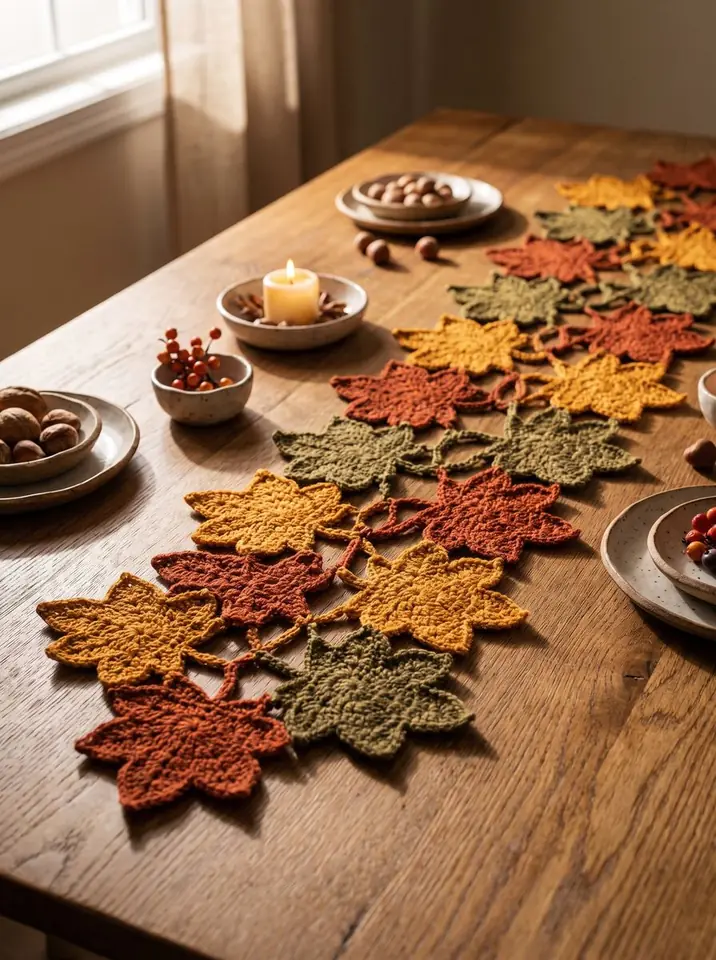
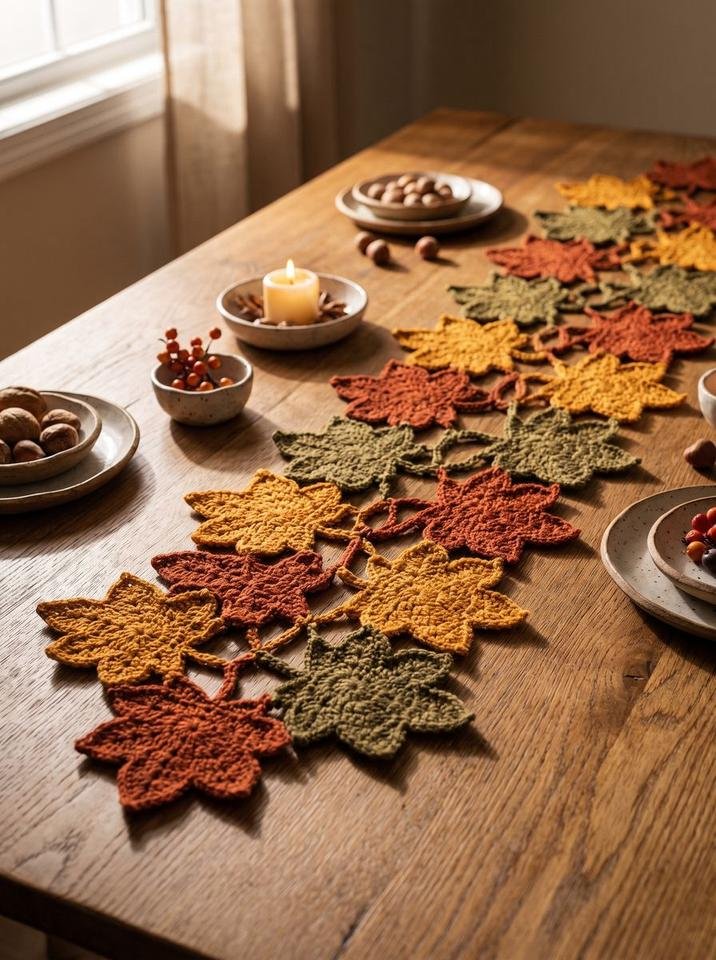
This project uses eighteen individual leaves crocheted in a rhythmic rotation of olive green, warm ochre gold, and deep rust orange. Rather than joining rows in rigid straight lines, the leaves overlap naturally at thirty-degree angles to mimic the organic scatter of fallen autumn foliage.
You can assemble the runner using either the join-as-you-go method or by blocking all motifs first and joining them with discreet needle whipstitches on the wrong side. The whipstitch method gives you greater freedom to test color arrangements on your tabletop before locking the layout into place permanently.
Because table runners often support warm serving platters and condiment bowls, using 100 percent natural cotton yarn is essential. Cotton will never melt or scorch under hot stoneware, and it washes clean in cold water if cranberry sauce or gravy spills during dinner.
3. Scalloped Maple Leaf Edge Placemat
Framing circular linen or cotton cloth placemats with delicate crocheted leaf points brings heirloom restaurant elegance to everyday dining settings.

In this project, a pre-cut circle of sturdy woven cotton or linen cloth forms the functional dining center, while an intricate border of golden crochet maple leaves flows outward to frame your dinnerware. This hybrid construction prevents cutlery and plates from catching on crochet holes while offering handcrafted artisanal beauty around the rim.
To attach the crochet trim, begin by piercing small evenly spaced holes around the fabric perimeter with a sharp awl or large embroidery needle. Work a foundational round of blanket stitch in matching thread, then crochet single crochet stitches directly into each blanket loop to build your working foundation.
If you love designing coordinating textiles for your home, exploring our extensive crochet home decor patterns collection will provide matching patterns for table settings, wall hangings, and decorative pillow trims across every season.
Work the leaf edging using a three-round repeat of arches and picots that blossom into miniature five-point leaves. Steam block the finished placemat under a damp pressing cloth to ensure every outer tip lies crisp and flat against your dining table.
4. Circular Fall Candle Ring Mat
Candlelight is the heart of cozy autumn dinners. A circular wreath mat crocheted from rich autumn leaves creates a protective, heat-safe ring around glass pillar candles.

This design connects six medium-sized maple leaves in a continuous ring around an open center hole sized to fit standard four-inch glass pillar candle holders. By staggering rich shades of crimson, rust, and harvest gold, the piece catches the flickering glow of candle flames with remarkable warmth.
Begin by crocheting a foundational ring of twenty-four chain stitches joined into a circle. Work a dense round of single crochet stitches around the ring, then build each leaf upward directly from the center ring foundation without cutting your working yarn between sections.
Sara's Studio Tip: For safety, always position real wax candles inside glass jars or ceramic lanterns when pairing them with crochet table decor. This prevents stray open flames from contacting fiber edges while protecting your handmade stitches from direct wax drips.
This candle mat also doubles as a stunning base for holiday centerpieces, supporting ceramic pumpkin tureens or small flower vases filled with dried wheat stalks and eucalyptus.
5. Rustic Twine Maple Leaf Garland & Table Bunting
Draped down the middle of a dining runner or hung along a buffet sideboard, a natural leaf garland tied with rustic jute twine brings relaxed cottage charm to autumn entertaining.

For quick seasonal decorating, a strand of rustic twine adorned with colorful crocheted leaves delivers maximum visual impact with minimal construction time. You can lay this garland directly over a neutral linen runner, weave it through brass candle holders, or drape it across a dining room credenza.
Crochet nine to twelve flat maple leaves using scrap yarn in moss green, burnt sienna, and mustard gold. While working the final stem round on each leaf, crochet a small three-chain hanging loop at the tip of the stem. This loop allows you to slide leaves directly onto natural hemp twine without knotting or gluing.
Pairing these foliage motifs with three-dimensional crocheted accents creates a breathtaking tablescape. You can easily combine this garland with our popular herringbone single crochet stitch tutorial to scatter plump ribbed pumpkins, real acorns, and cinnamon sticks across your holiday table.
Space the leaves six inches apart along the twine, securing each leaf in place with a small wooden bead or a knot of contrasting twine to prevent sliding when the garland is moved or repositioned.
6. Dainty Autumn Leaf Napkin Ring Charm
Small personal details make dinner guests feel cherished. A miniature crocheted maple leaf charm tied around rolled cloth napkins sets a thoughtful, handcrafted tone at every place setting.

Unlike bulky commercial napkin rings that consume storage space between holidays, these flat crochet leaf charms store effortlessly in a drawer and can be reused as gift tags, ornament hangers, or bookmark markers throughout the winter season.
Working in fine fingering weight cotton with a 2.75 mm hook yields a delicate, jewel-like leaf measuring just two and a half inches across. The stitch pattern consists of a quick three-round motif: a round of single crochet stitches into a magic circle, a round of double crochet clusters, and a rapid picot edging that carves five distinct leaf points.
To style the table setting, roll raw-edge linen napkins into clean cylinders, wrap them twice with natural jute cord or cotton ribbon, and thread both cord ends through the leaf stem before tying a loose bow. Your guests can take their leaf charms home as handmade keepsakes.
7. Raised-Vein Textured Cotton Hot Pad & Trivet
When transferring heavy cast iron skillets or bubbling ceramic bakers from the oven directly to the dining table, a thick, double-layered cotton trivet provides essential thermal protection.

Standard flat crochet motifs can be too thin to stop intense oven heat from reaching sensitive wood finishes. This trivet pattern solves that problem by incorporating pronounced front post treble crochet stitches that create deep, raised veins across the leaf surface.
These raised structural veins serve two critical functions: they add substantial density and thickness to the fabric, and they create a miniature air buffer beneath hot baking pans. This air gap prevents moisture condensation from collecting against wood tables when steaming cookware rests on top.
Sara's Studio Tip: Never use acrylic or polyester yarn for kitchen hot pads and table trivets. Synthetic fibers melt when exposed to cookware exceeding three hundred degrees Fahrenheit. Always verify that your yarn band reads 100 percent cotton, linen, or wool.
Weave your tail ends securely through the back ridge loops rather than surface stitches. This ensures the underside remains smooth, protecting fine wooden tables from friction scratches during dinner service.
8. Fine Lace Thread Maple Leaf Doily
For vintage tablescapes, dessert sideboards, or afternoon tea trays, a fine lace crochet leaf worked in mercerized cotton thread brings timeless botanical delicacy to the room.

This design celebrates vintage filet and pineapple lace techniques reimagined in an authentic maple leaf silhouette. The open mesh stitches allow the natural grain of polished oak and walnut tables to show through the lace, casting delicate shadows in soft afternoon light.
Working with size 10 cotton thread requires steady, relaxed hand tension and good studio lighting. If you have been searching for a crochet maple leaf pattern free from rigid modern geometry, this vintage openwork silhouette offers graceful historical curves.
Because thread lace lacks the heavy structure of worsted yarn, wet blocking is mandatory for this piece. Soak the completed doily in lukewarm water, squeeze gently in a dry cotton towel, and pin every picot point firmly to a blocking board until dry.
9. Heathered Marled-Yarn Leaf Centerpiece Mat
Holding two different yarn colors together while crocheting creates an organic tweed effect that mirrors the natural mottled color transitions of real autumn leaves falling from trees.

In nature, maple leaves rarely display a single flat color. As chlorophyll breaks down in October, golden yellows, deep carmines, and earthy browns blend together across each leaf blade. Holding two lightweight strands of contrasting yarn together captures this natural beauty perfectly.
Combine one strand of burnt orange yarn with one strand of mustard gold, working both strands simultaneously with a 5.0 mm hook. This double-strand technique works up twice as fast as single-strand crochet while producing a sturdy, dense fabric with wonderful visual depth.
This ten-inch mat makes an ideal centerpiece anchor under ceramic fruit bowls, rustic bread baskets, or stoneware salt and pepper cellars in the center of your dining table.
10. Harvest Gathering Leaf Place Card Setting
Welcome friends and family to your holiday table with personal place cards featuring a miniature crocheted leaf motif that guests can take home as a memorable keepsake.

A beautifully set holiday table is about more than just food; it is an invitation for conversation and celebration. Pairing miniature handcrafted crochet leaves with torn-edge kraft paper cards adds warmth and intentionality to every seat at your table.
These petite leaves can be completed in just fifteen minutes each, making it easy to create eight or twelve place markers in a single weekend. The pattern uses simple single and half double crochet stitches with small picot tips that lay flat without complex blocking.
Style each place setting by writing your guest's name on brown kraft cardstock with dark sepia ink. Place the crocheted leaf beside a small bundle of dried wheat stalks or lavender tied with hemp twine for an effortlessly polished autumn aesthetic.
Selecting the Right Yarn Fiber for Table Linens
Choosing the correct yarn fiber is the most important factor in ensuring your autumn table accessories remain flat, heat resistant, and easy to clean through years of seasonal gatherings.
100 Percent Cotton: Cotton is the indisputable champion for kitchen and dining accessories. Unlike synthetic fibers, cotton absorbs spills instantly, tolerates boiling water and machine laundering, and will not melt when placed beneath hot teapots or warm serving dishes. Unmercerized cotton offers soft, matte rustic appeal, while mercerized cotton provides subtle sheen and superior stitch definition for intricate lace doilies.
Linen Blends: Blending linen with cotton yields exceptional structural durability. Linen fibers soften with age, resist mildew, and provide natural crispness that helps leaf points hold their shape across long dinner parties. Linen-cotton blends are particularly suited for placemats and table runners.
Pure Wool: While wool is naturally flame retardant and cushions heavy cookware beautifully, it requires gentle hand washing to avoid unintended felting. Reserve wool yarns for wall garlands and decorative table runners that will not encounter direct food or liquid spills.
Studio Secrets for Blocking and Stiffening Crisp Leaf Points
Freshly crocheted leaves often curl at the perimeter because treble stitches and picot points pull unevenly on the foundation fabric. Proper blocking transforms curled motifs into flat, professional table decor.
Steam Blocking for Table Runners and Coasters: Pin your completed leaf onto an interlocking foam blocking mat using rust-proof stainless steel T-pins. Place one pin through the central stem, one through each lobe cleft, and one through every picot tip, pulling outward gently to establish symmetrical geometry. Hover a steam iron two inches above the fiber, releasing generous steam pulses for twenty seconds. Allow the fiber to cool and dry completely before removing pins.
Light Stiffening for Garlands and Wreaths: If your leaves will hang freely in a garland or rest beneath floating candle holders, they benefit from light structural stiffening. Dissolve one tablespoon of cornstarch in one cup of cold water, heat gently until translucent, let cool, and lightly brush over the wrong side of your pinned leaves. This provides subtle crispness without leaving sticky synthetic residue.
Autumn Table Styling and Ceramic Pottery Pairing
Integrating handcrafted textile accessories with ceramic dinnerware creates balanced, layered warmth across your dining space.
Contrasting Earth Tones: Pair burnt terracotta and rust leaf mats with speckled cream or sage green stoneware plates. The contrast between matte glazed ceramic surfaces and the ribbed cotton stitches brings dynamic visual rhythm to the table.
Natural Elements: Complete your leaf runner by scattering real seasonal botanical elements along the center board. Mini heirloom pumpkins, dried acorn caps, cinnamon sticks, and sprigs of fresh rosemary infuse the dining room with gentle seasonal fragrance and woodland charm.
Frequently Asked Questions
What is the best yarn for crocheting autumn leaf coasters and table mats?
Unmercerized or lightly mercerized 100 percent cotton yarn is the gold standard for crochet table accessories. Cotton absorbs hot beverage condensation effortlessly, resists scorching from ceramic mugs or tea kettles, and maintains stitch crispness through repeated studio washings.
How do you keep crochet maple leaf points from curling upward?
Curling leaf tips are corrected through proper steam blocking. Pin each picot point outward on a foam mat using stainless steel T-pins, then hover a hot steam iron two inches above the fiber for twenty seconds before letting the piece dry completely flat.
Can I connect individual crochet maple leaves into a long table runner?
Yes, you can join leaves using either a join-as-you-go slip stitch method at the leaf lobes during the final round or by whipstitching the lobes together on the wrong side with matching cotton yarn.
How do I make my crochet leaves stiffer for garlands and candle mats?
For decorative pieces that do not absorb spills, apply a diluted mixture of equal parts craft glue and warm water, or use laundry starch spray. Pin the wet leaves into shape on parchment paper until fully cured.
What crochet hook size works best for worsted weight leaf patterns?
A 4.0 mm (US G/6) or 4.5 mm (US 7) hook provides the ideal balance for worsted weight yarn. It creates a dense, non-floppy fabric that protects wood tabletops from heat while preserving clean stitch definition.
Working through each project in this curated roundup will deepen your textile skills while filling your home with cozy autumnal elegance. Whenever you are ready to start your next dining project, picking up a versatile crochet maple leaf pattern free from unnecessary complexity ensures your table will remain warm, inviting, and wonderfully handmade all season long.