
A crochet stitches cheat sheet answers the two questions every beginner asks in the middle of a row: what does this abbreviation mean, and how tall should the stitch be? This guide covers the five stitches behind almost every pattern, with their US and UK names, their symbols and the turning chain each one needs.
The sheet is also a swatch. You work one band per stitch in five colors, two rows each, and the stitches grow taller as the cloth rises. When a pattern says double crochet, you hold the sampler next to your work and check the height by eye instead of decoding a chart.
Stitch names cause most of the confusion. A pattern written in US terms calls the shortest stitch single crochet, while a UK pattern calls the very same stitch double crochet. The table below lists both names, so you never have to guess which system you are reading.
Table of Contents 15 sections
Crochet Stitches Cheat Sheet: Names, Symbols and Turning Chains
Keep this table open while you work the sampler. The height column shows why each stitch needs a different turning chain.
| Stitch | US Abbreviation | UK Name | Chart Symbol | Turning Chain | Height in Chains |
|---|---|---|---|---|---|
| Chain | ch | chain (ch) | Small oval | Not applicable | Foundation row |
| Slip stitch | sl st | slip stitch (ss) | Filled dot | None | Flat, used to join |
| Single crochet | sc | double crochet (dc) | Plus sign or X | 1 chain, usually not counted | 1 |
| Half double crochet | hdc | half treble (htr) | T shape | 2 chains, often counted | 2 |
| Double crochet | dc | treble (tr) | T with one slash | 3 chains, counted | 3 |
| Treble crochet | tr | double treble (dtr) | T with two slashes | 4 chains, counted | 4 |
Step 1: Gather Yarn, Hook and Tools for the Sampler

Pick one smooth, tightly plied mercerized cotton for the whole sampler and give each stitch its own color. Cotton keeps every strand distinct, so the posts, the top loops and the turning chain stay easy to read once the cloth is finished and lying next to the pattern you are following.
Use a 4.5 mm hook with worsted weight cotton for a firm cloth where each stitch holds its shape. The yarn label will often suggest a larger hook, which suits drapey projects, but a reference swatch should be dense enough that you can count the posts and compare row heights.
Yarn Weight and Hook Size Pairing
Label ranges are a starting point. Go down half a millimeter for a firm cloth like this sampler, and up half a millimeter for drape.
| Yarn Weight | Typical Hook Range | Good For |
|---|---|---|
| Fingering | 2.25 to 3.5 mm | Lace, shawls and fine edgings |
| Sport | 3.5 to 4.5 mm | Baby clothes and light cardigans |
| DK (light worsted) | 4.5 to 5.5 mm | Sweaters, toys and accessories |
| Worsted | 5.5 to 6.5 mm | Blankets, hats and bags |
| Bulky | 6.5 to 9 mm | Quick scarves and cozy throws |

From our shop
Wildflower Bandana
A light triangle headscarf in cotton with rows of open flower motifs, long ties and a scalloped picot border. PDF pattern in US terms.
Get the pattern for $0.99 →Digital download. Nothing is shipped.
Step 2: Make a Slip Knot and Foundation Chain
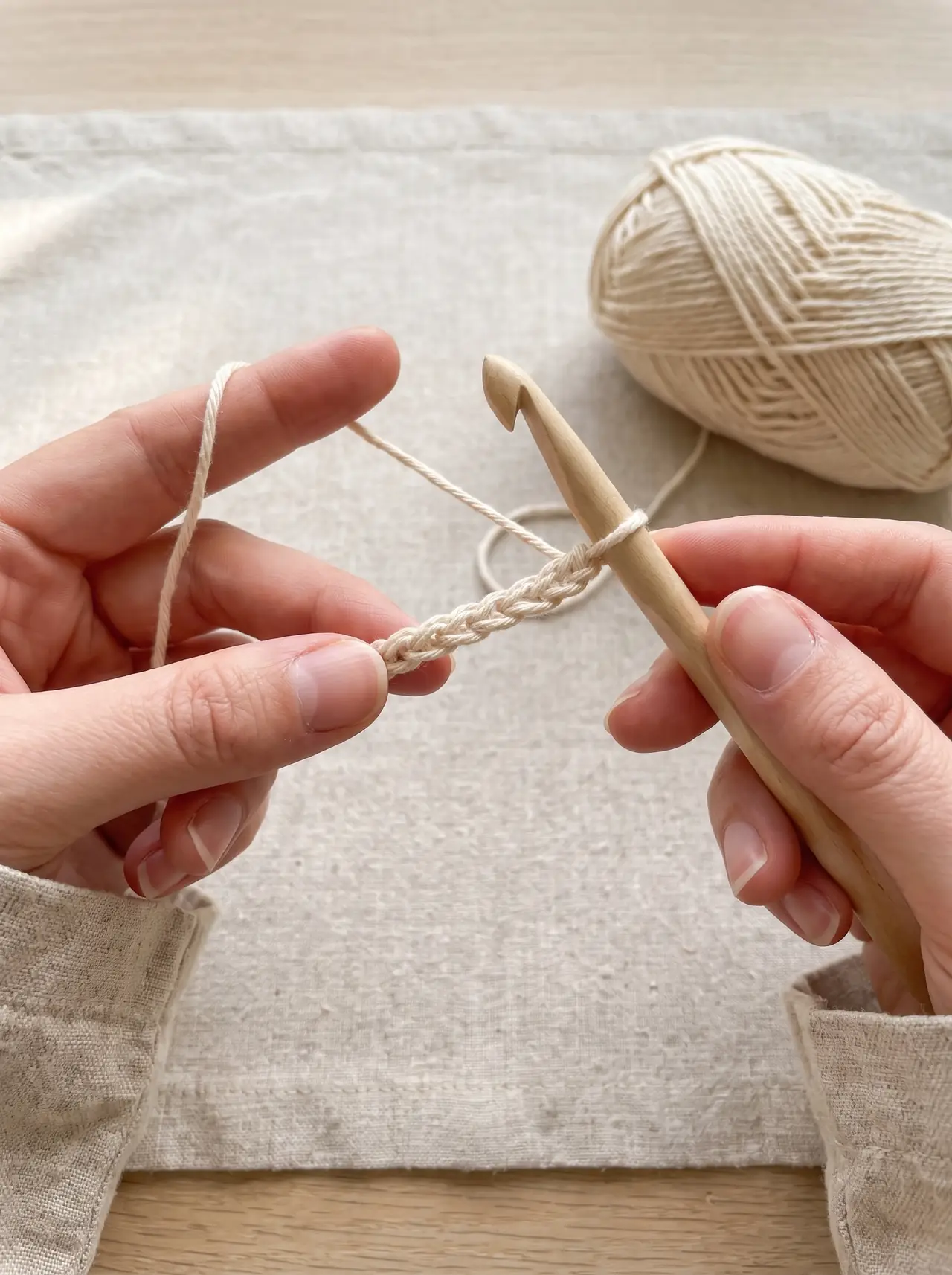
Make a slip knot, slide it onto the hook and tighten it until it moves freely but does not wobble. Hold the knot between your left thumb and middle finger, and wrap the yarn over your left index finger. That finger controls your tension for every stitch that follows, so keep it steady.
To chain, yarn over and pull the yarn through the loop on the hook. Repeat until you have 25 chains, which gives a sampler of about 24 stitches plus one chain to turn. Do not count the loop on the hook, and count the V-shaped links on the front, which are easier to see than the bumps behind.
The slip stitch is the flattest crochet stitch and rarely makes a visible row. Insert the hook, yarn over and pull through both the fabric and the loop on the hook in one move. You use it to join rounds, to travel along an edge and to finish a motif.
Step 3: Single Crochet, the Shortest Stitch

Printable version: download the one-page crochet stitches cheat sheet (PDF) with US and UK names, abbreviations, chart symbols and turning chains, ready to print and keep next to your hook.
Single crochet is the stitch to learn first. Insert the hook into the second chain from the hook, yarn over and pull up a loop so two loops sit on the hook. Yarn over again and pull through both loops. One loop remains, and that is one finished stitch.
Work one single crochet in every chain across, then chain 1 and turn. This turning chain lifts the yarn to the height of the next row, and it does not count as a stitch, so the first single crochet of the new row goes into the very first stitch below.
Step 4: Half Double Crochet, One Yarn Over Taller
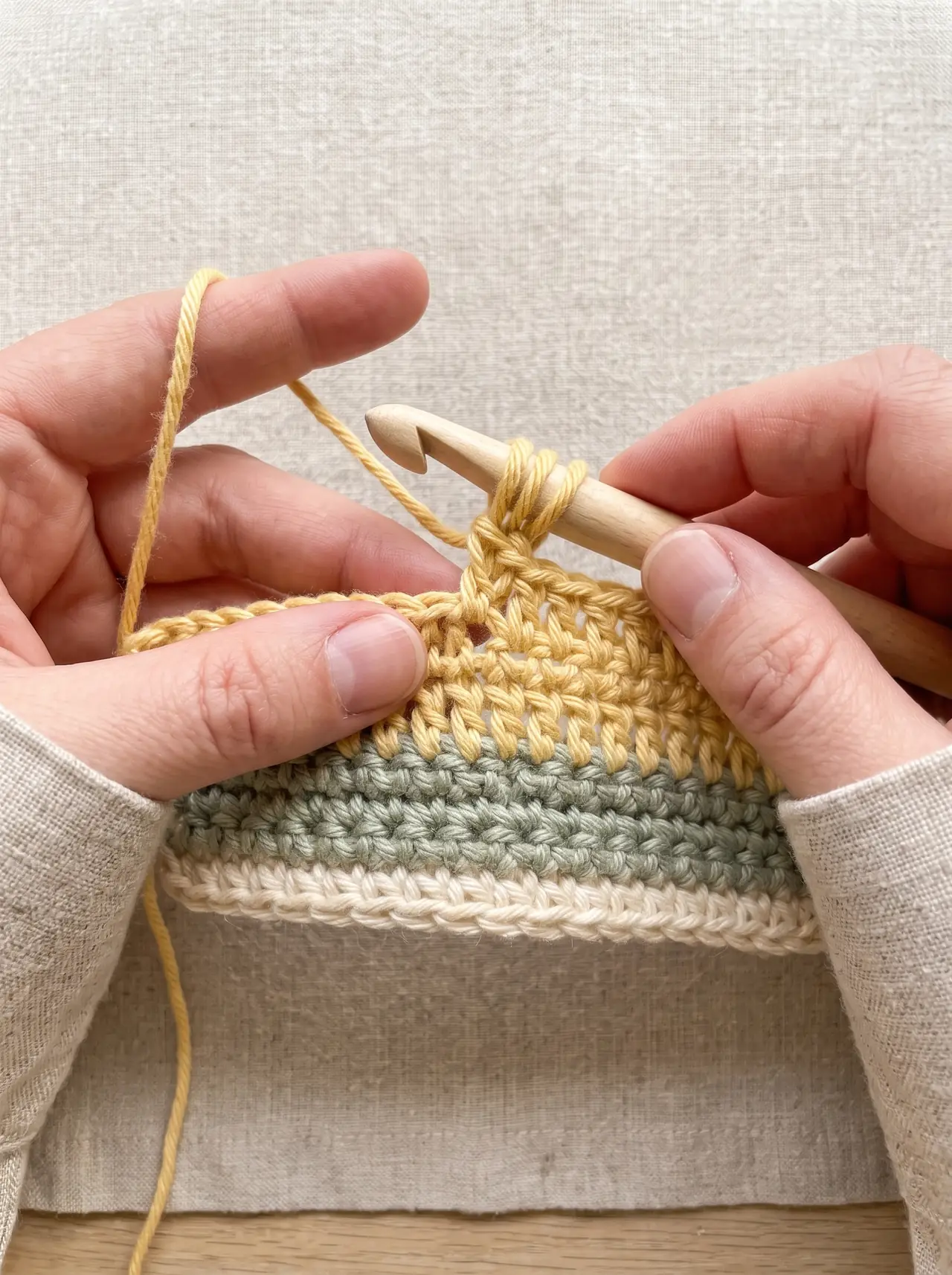
Half double crochet begins with a yarn over before you insert the hook. Insert it into the next stitch, yarn over and pull up a loop, and three loops now sit on the hook. Yarn over once more and pull through all three loops in a single motion.
That extra wrap makes the stitch about twice as tall as a single crochet, and it leaves a small horizontal bar just below the top loops. The bar is a handy landmark: you can see it from the back of the work when you need to check where a row began.
Step 5: Double Crochet, the Workhorse Stitch
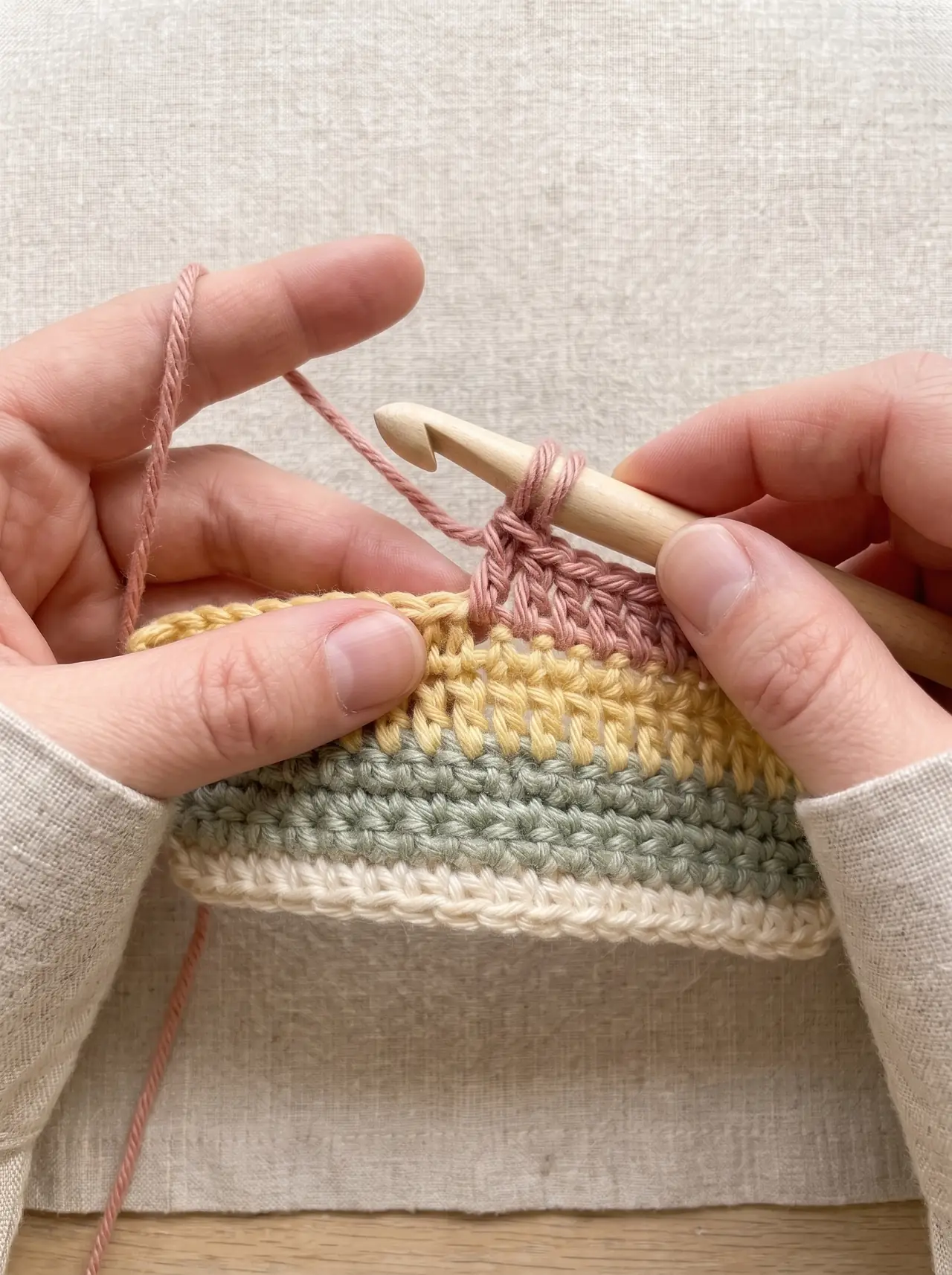
Double crochet is the stitch most patterns lean on. Yarn over, insert the hook into the next stitch, yarn over and pull up a loop to leave three loops on the hook. Yarn over and pull through two loops, which leaves two on the hook, then yarn over and pull through the last two.
Counting loops is the safest habit. If you ever lose your place mid-stitch, you can read the loops on the hook and know exactly which move comes next. The turning chain is 3, and it counts as the first stitch, so the first double crochet of the row goes into the second stitch.

From our shop
Botanical Lace Flower Bookmarks
Three lace flower bookmark designs in two colorways each, worked in thread with a steel hook. PDF pattern in US terms with photos and charts.
Get the pattern for $0.99 →Digital download. Nothing is shipped.
Step 6: Treble Crochet, Two Wraps Before You Start
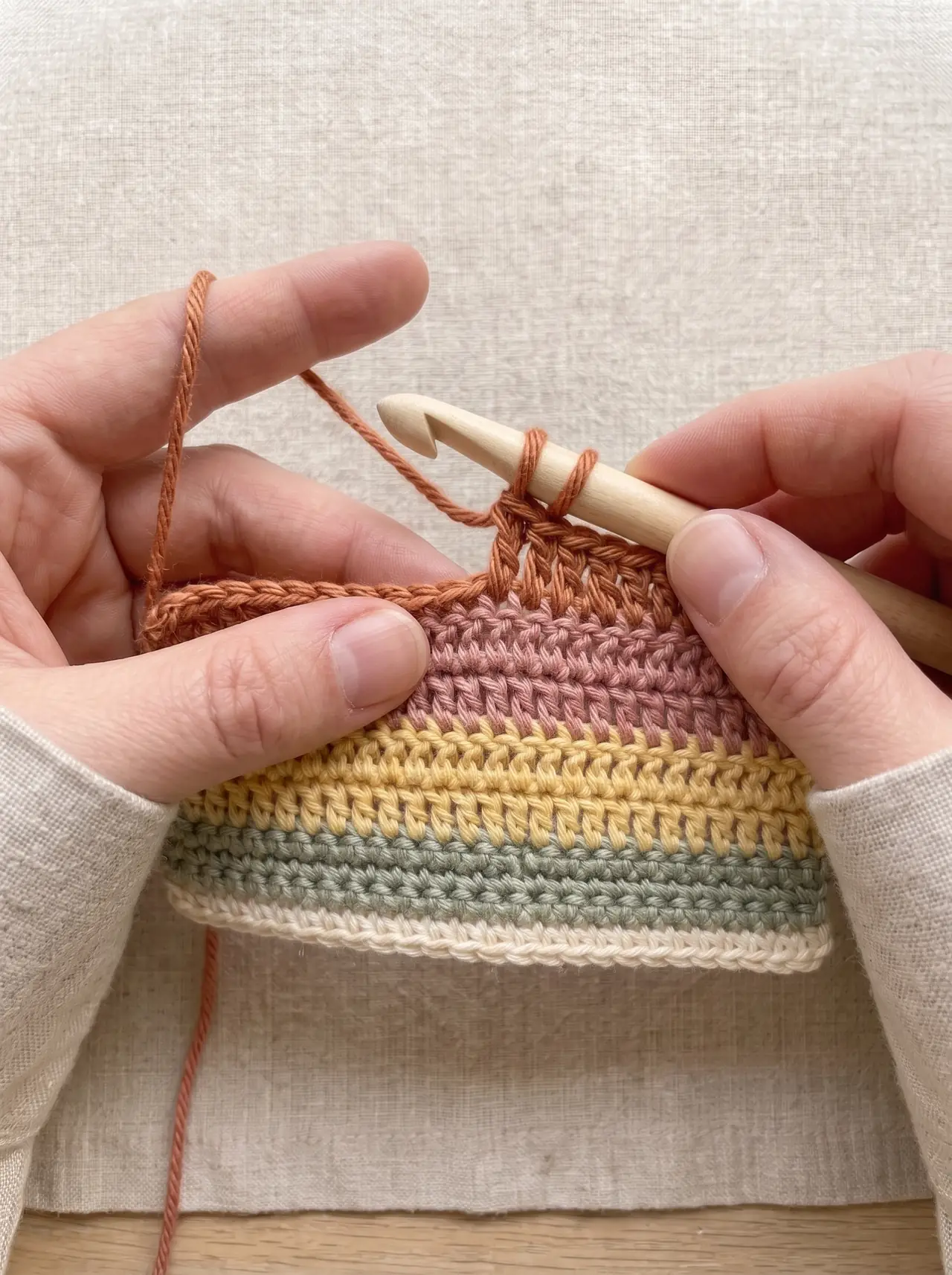
Treble crochet starts with two yarn overs before you insert the hook. Wrap the yarn twice around the hook, insert it into the next stitch, then yarn over and pull up a loop. Four loops sit on the hook, and you close them in three pull-throughs of two loops each.
Learning it last makes sense. Once single, half double and double crochet feel automatic, the extra wrap barely registers, and you can build on the idea in our crochet beginner guides, where hook sizes and yarn weights are matched to each project.
Step 7: Match the Turning Chain to the Stitch Height
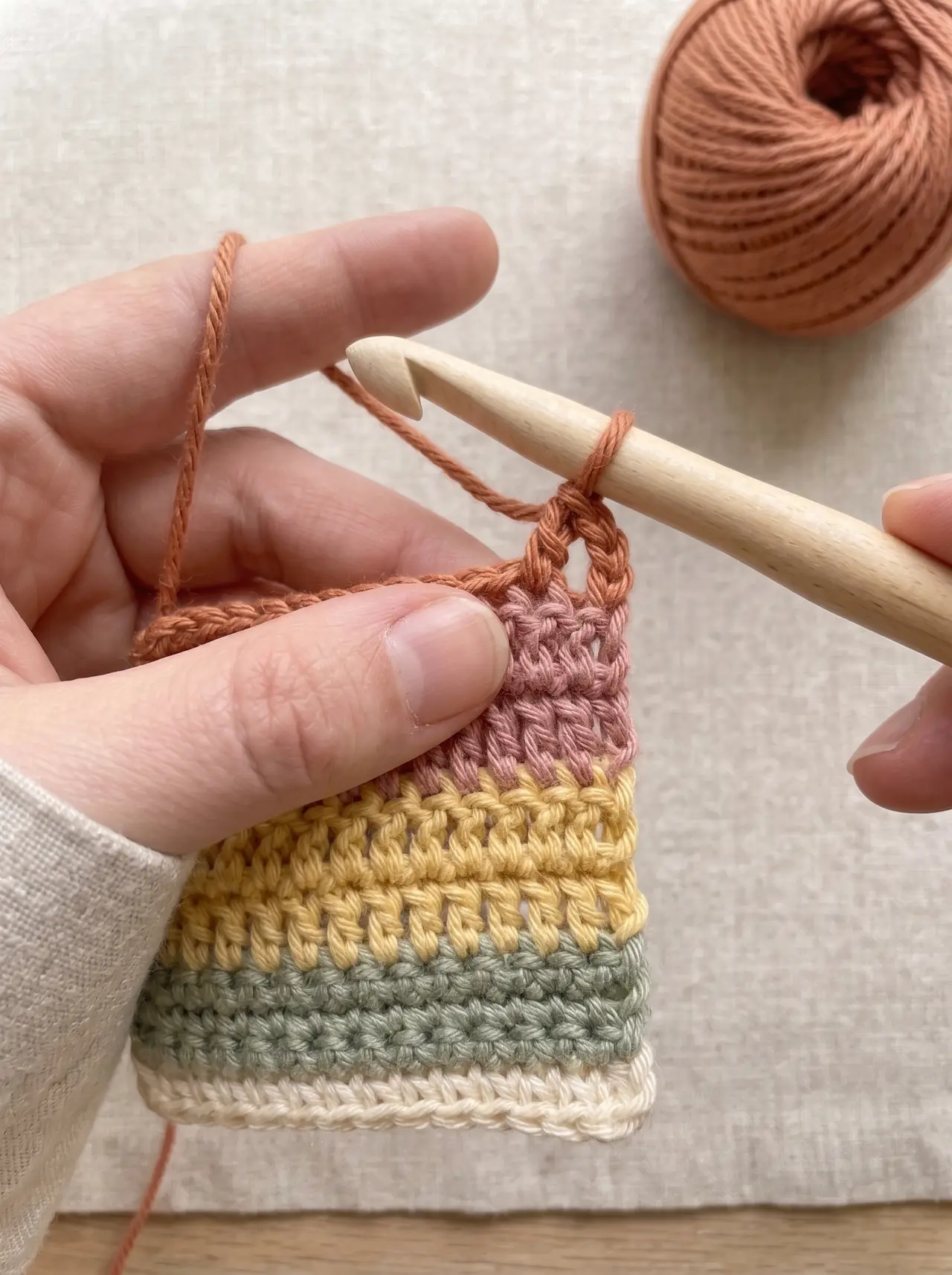
A turning chain is simply a short chain that brings your hook up to the height of the stitch you are about to make. Without it, the first stitch of a row would be too short and the edge would pull inward. Work it and the chain stands up at the edge like a small bridge.
Whether the chain counts as a stitch decides where you work next. If it counts, as it usually does for double and treble crochet, skip the stitch at its base and work the first real stitch into the second one. If it does not count, as with single crochet, work into the base stitch.
Step 8: See Every Stitch Height Side by Side

Read the finished bands from the bottom up. You get a thin chain edge, then short, tight sage single crochets, slightly taller butter-yellow half doubles, clearly higher dusty-rose doubles and tall terracotta trebles at the top. That staircase is the whole cheat sheet.
Use it to check gauge. Measure a swatch of your own against the sampler, and if your double crochet is noticeably shorter than the rose band, your tension is tight. A looser tension makes stitches taller and also wider, so measure rows and stitches, not just height.

From our shop
Mini Holiday Green Monster
A small, cheeky green plushie worked from the toes up, with an embroidered smirk, a curly hair tuft and a striped scarf. PDF pattern in US terms.
Get the pattern for $0.99 →Digital download. Nothing is shipped.
How to Read Crochet Abbreviations and Symbols in a Pattern
Patterns shorten everything, so learn the crochet abbreviations once and they work everywhere. Common ones beyond the table are inc for increase, dec for decrease, sk for skip, st for stitch, rep for repeat, rnd for round and sp for space. Always read the pattern notes first, because designers add their own.
Check whether the pattern uses US and UK terms before you start. If a pattern lists single crochet, it is US. If it lists a double crochet but never mentions a half treble or a treble, it is probably UK. The stitch photos or a chart symbol will confirm which stitch is meant.
Crochet symbols appear in charts, where each stitch is a small drawing: an oval for a chain, a dot for a slip stitch, a plus sign for single crochet and a T with slashes for the taller stitches. Each slash is one extra yarn over. Read a round chart from the center out, and a flat chart from the bottom up.
Step 9: Finish Your Crochet Stitches Cheat Sheet Sampler

Cut each color, leave a six inch tail and weave the ends into the back of the matching band with a tapestry needle. Cotton does not need much shaping, so a light mist of water and a gentle press flat with your palm is enough to settle the stitches and straighten the edges.
If the sides slant, count your stitches in each band. A wavy right edge means you gained a stitch each row, and a drawn-in edge means you lost one. Rework the band if it bothers you, because a sampler with straight sides is also a gauge swatch that you can trust.
Step 10: Hang the Sampler Where You Crochet

Hang it where you crochet, on a wall or a corkboard, and you will check it far more often than a page in a drawer. A jute string and two wooden pegs show the bands clearly and keep the cloth flat, and a shelf below holds your hook within reach.
If you want a stitch beyond the basics, the same sampler method works. Our herringbone single crochet tutorial builds a textured stitch from the single crochet you have just learned, and you can add it as a sixth band.
Fix Common Stitch Problems
The edges get wider every row. You are probably working into the base of a turning chain that counts as a stitch, or adding an extra stitch at the end. Count at the end of each row, and mark the first stitch with a removable marker until your edges stay straight.
The edges get narrower. You are skipping the last stitch, usually the top of the turning chain. Work into the top of the chain 3 or chain 4 at the end of a double or treble crochet row so the stitch count stays the same.
Holes appear at the start of rows. The turning chain is too loose or too long for the stitch. Match the chain to the height in the table, and tighten the first stitch after the chain with a small tug on the working yarn.
Frequently Asked Questions
Is US single crochet the same as UK double crochet?
Yes. The stitches are made the same way, but the names are shifted by one step. US single crochet is UK double crochet, US double crochet is UK treble crochet, and so on up the scale. A pattern's abbreviations page tells you which system it uses.
Does the turning chain count as a stitch?
It depends on the stitch and the pattern. Chain 1 for single crochet usually does not count. Chain 2 for half double crochet sometimes counts. Chain 3 for double crochet and chain 4 for treble crochet normally count, so you skip the stitch at the base.
What hook size should I use for worsted weight yarn?
Labels usually suggest 5.5 to 6.5 mm. For a firm cloth with cotton, many crocheters go down to 4.5 or 5 mm. Make a small swatch, count the stitches in four inches, and adjust the hook until the count matches your pattern.
A crochet stitches cheat sheet works best when you can touch it. Work the five bands once, keep the sampler where you crochet and read the names, heights and turning chains straight off the cloth, so every new pattern starts from a stitch you have already made.
Save This for Later
Pin this guide to your crochet board so it is ready when you start your next project.
Save on Pinterest