Crochet grid work builds pictures and textures from squares: filled and open boxes in filet crochet, colored blocks in corner-to-corner and tapestry crochet, and plain chain-space mesh for bags and throws. All of it comes down to one skill, which is counting squares across a row.
A row of blocks, a row of holes, and suddenly you have a lace curtain, a market bag or a blanket with a picture hidden in it. Once you can read a grid chart, you can design your own with nothing more than graph paper and a pencil.
The fifteen ideas below use the grid in different ways, from beginner mesh to charted colorwork. For each one I explain which grid technique it uses, the yarn and hook that suit it, and how I would plan it before the first chain.
Jump to a Section
Crochet Grid Techniques at a Glance
Each technique reads the grid differently. Pick the one that matches your patience and your project.
| Technique | How a Square Is Made | Best For | Skill | Speed |
|---|---|---|---|---|
| Filet crochet | Open: dc plus 2 ch. Filled: 3 dc | Curtains, runners, wall art | Intermediate | Slow |
| Chain-space mesh | Dc or sc plus chain spaces | Bags, throws, shawls | Beginner | Fast |
| Corner to corner (C2C) | One tile of 3 dc on a diagonal | Checkerboards, pixel pictures | Beginner | Medium |
| Tapestry crochet | One sc per pixel, carried color | Pillows, small motifs | Intermediate | Slow |
| Granny squares | A whole motif per square | Blankets, cushions | Beginner | Medium |
1. An Indigo Filet Throw With a Hidden Motif

An open square is one double crochet followed by two chains; a filled square is three double crochets. For a 40-inch throw in DK yarn, a chart around 110 squares wide works well.
Pick a heathered or washed shade for a denim-like look. A smooth yarn keeps the squares crisp, while a fuzzy one blurs the motif you spent hours charting.
Sara's Studio Tip: For a large filet piece, chart one repeat on graph paper and photocopy it. Cross off each row in pencil as you finish it.
2. A Cream Wall Hanging With a Raised Landscape

Start with a filet panel and fill the area of your landscape with solid squares. Then build height on top of those solid areas by working rows of surface crochet or small popcorn clusters into the filled blocks, adding more layers where you want the ridge to rise.
Finish the top with a row of chain loops and slide a walnut or oak dowel through them. Cotton is the right fiber here because it blocks well and will not sag off the rod.
3. A Sunset Granny Stripe Blanket

Work the blanket in rows of granny clusters and change color every 8 to 10 rows. To get the stepped look, change color at a different point along the row each time, carrying the old color behind a few clusters before cutting it.
An acrylic blend is the practical choice for a porch. It handles sun, outdoor dust and the occasional spilled coffee, and it machine washes without fuss.
4. A Sage and Cream Checkerboard Blanket

In corner-to-corner crochet, each tile is a chain 3 plus 3 double crochets worked on the diagonal. Switch colors every tile within a diagonal row and the checkerboard forms by itself. For smaller checks, work blocks of 3 stitches by 2 rows and swap colors every block.
Sage and cream suits a nursery, a sofa or a guest room. Two colors also means fewer ends to weave in.
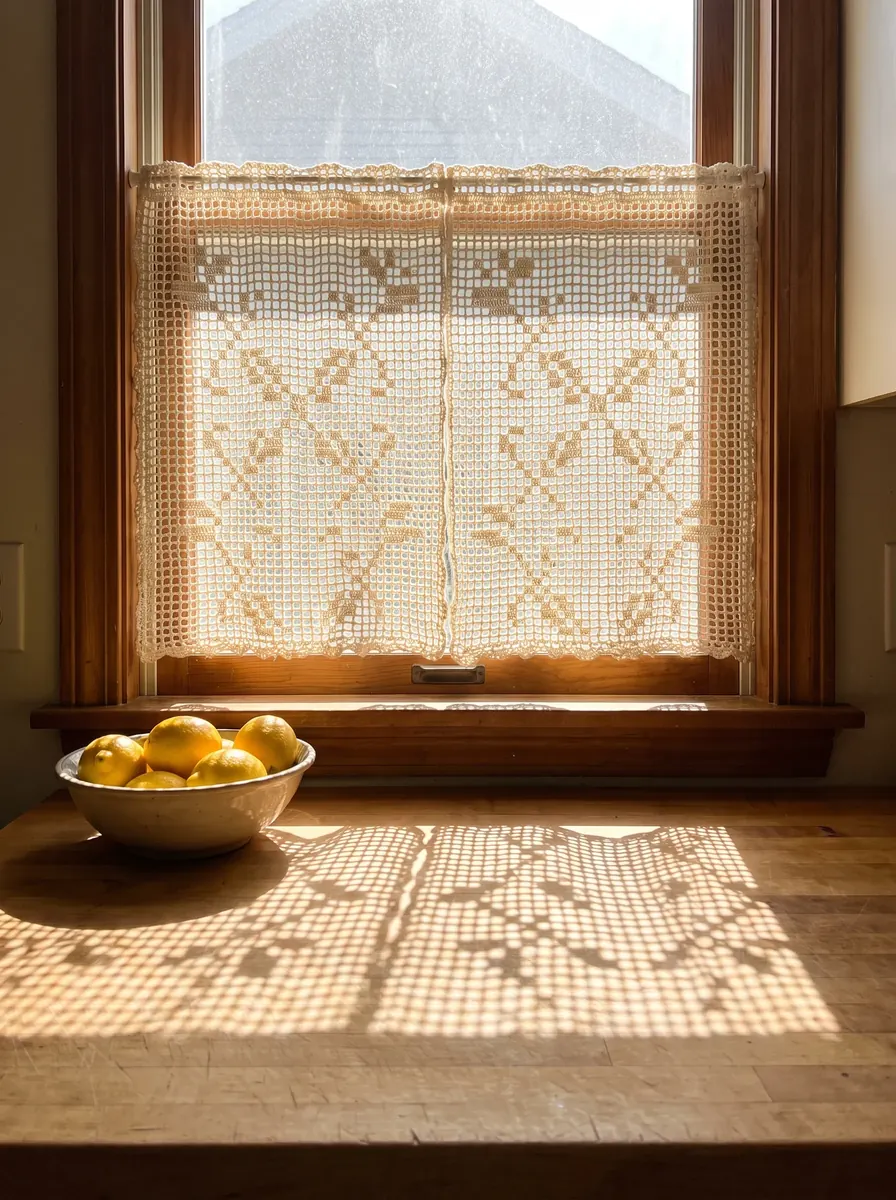
5. A Vintage Filet Cafe Curtain

Measure the lower half of your window and divide the width by two for two panels. In size 10 thread, one filet square is about a quarter inch, so a 15-inch panel is about 60 squares wide.
Add a scalloped lower edge: work groups of 5 double crochets into every other square along the last row. Leave a row of open squares across the top for the curtain rod.
Thread crochet is slow. Start with one small panel before you commit to a full window.
6. A Mesh Market Bag That Stretches

Chain 4, join, and work a flat circle of double crochet to about 6 inches across. Then switch to mesh rounds: (chain 5, sc into the next chain space) around. About 20 mesh rounds make a deep bag.
Finish with four rounds of solid single crochet for the top band. For the handles, chain 80 on each side, skip a third of the band and attach the chain, then work single crochet back over each chain twice for strength.
For more pieces you can use around the house, browse our crochet home decor collection.
7. A Neutral Sixteen-Square Baby Blanket

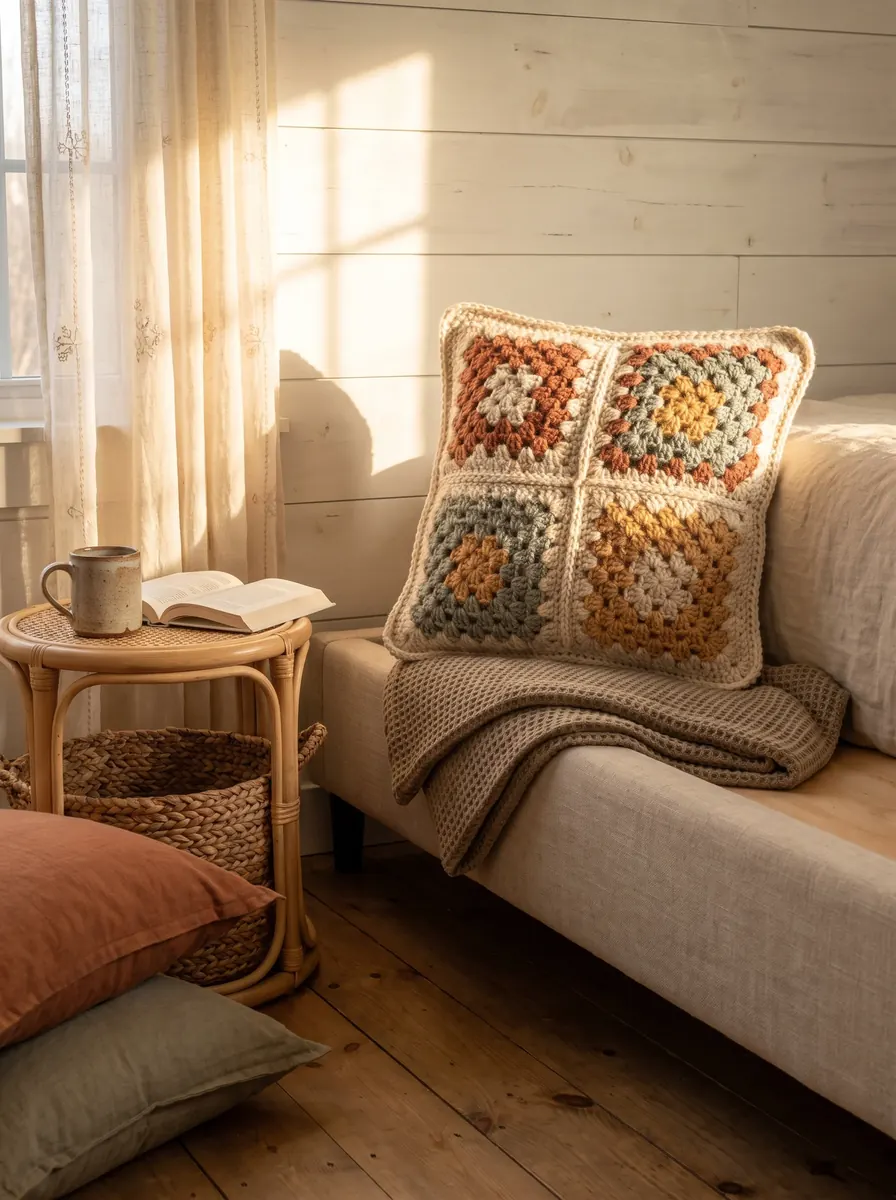
The squares do not have to match. Mix solid squares worked in rounds of half double crochet with classic granny squares and squares worked in rows. As long as every square reaches the same size, about 7 inches, they will join flat.
Scatter the terracotta squares so no two touch, then join all of them in cream with a flat slip-stitch seam. Finish with two rounds of cream single crochet around the edge.
8. A Black Filet Table Runner

A long, narrow runner is a forgiving first filet project, because the pattern only carries across about 45 squares. Chart one repeat of the motif and repeat it along the full length.
Dark thread is hard on the eyes. Count at the end of every row, not every ten rows. One missed chain space shifts the whole motif.
9. A Framed Squares Blanket in Blue, Rust and Cream

Work the center block in moss stitch (alternating sc and ch 1). Then pick up stitches along one edge and work a strip, turn the block and work along the next edge, and keep going around. Switch colors after each full frame.
Join four or six large blocks with a cream seam and add a wide blue border. Chunky yarn makes the whole thing quick, but pick a soft fiber, because cheap acrylic feels rough at this weight.
10. An Airy White Mesh Throw for Warm Weather

The grid is wide and even, with no motif at all. Work rows of (dc, chain 2, skip 2) and stack each double crochet on the one below. That simplicity makes it a good project to work while watching a film.
Finish with one row of single crochet around the edge to keep the mesh from stretching out of shape.
11. A Desert Cactus Filet Curtain

Charting a shape like this is easier than it looks. Trace a simple silhouette onto graph paper, then shade every square that is more than half inside the outline. Each shaded square becomes a filled block.
Work the sky in sand-colored cotton and the bottom band and motif in terracotta. Add a row of chain loops at the top and hang it from a rough wooden pole.
12. A Pixel Heart Pillow Charted on Graph Paper

Single crochet colorwork gives you the tightest pixels. Carry the unused color inside the stitches when the gap is short, and switch to separate bobbins when it is long, so the back stays tidy.
A pad of graph paper is the cheapest tool in your kit and saves you from ripping back twenty rows. Any simple silhouette works: hearts, stars, initials or a pet.
13. A Fog Grey Mesh Shawl

Work the net stitch: (chain 5, sc into the next chain-5 loop) across every row. The loops sit offset from row to row, which turns the square grid into diamonds.
Add small tassels along the lower edge to weight it so it hangs straight instead of curling. Wear it as a scarf, a shoulder wrap or a head covering.
14. A Black Mesh Plant Cage

Work a flat square or circle base the width of your pot. Then work mesh rounds of (dc, chain 2, skip 2) straight up to the height you want. Two rounds of solid sc at the top stop the cage from stretching.
Tie six long cords evenly around the top round and gather them in a knot or a metal ring. Test the hanger with the empty pot first, then add soil.
If you like grid pieces that shape a whole room, our crochet room decor ideas add fourteen more makes for every corner.
15. A Chunky Lattice Blanket in Ivory

Work the whole blanket in rows of single crochet through the back loop, which gives a flat, slightly ribbed panel. When it is finished, add the lattice by working surface slip stitch lines on top in the same yarn, both diagonally across the blanket at even spacing.
Grids work well at this scale because the squares are big enough to read without any motif. The blanket is often the only texture a calm room needs.
How to Read a Crochet Grid Chart
Every grid project follows the same rule. A filled square on the chart means a solid block, an empty square means an open space or the background color.
Read the chart back and forth. Odd rows go right to left, even rows go left to right, because you turn your work at the end of each row. Corner-to-corner charts are read on the diagonal instead.
Mark your current row with a sticky note or a magnetic board. Count the squares at the end of every row, and compare the shape you have made to the chart before moving on.
Choosing Yarn and Hooks for Grid Work
Smooth yarn shows squares, and fuzzy yarn hides them. Cotton, cotton blends and tightly plied acrylics give clean edges, while mohair and bouclé turn a careful grid into a blur.
Hook size changes the character too. Go up a size for airy mesh that drapes, and down a size for crisp filet with sharp squares.
Thread (size 10): Lace curtains, runners and doilies with fine detail. Use a 1.5 to 1.75 mm steel hook.
Worsted cotton: Wall art, bags and pillows. Use a 4 to 5 mm hook.
Chunky and super bulky: Fast blankets with big, simple grids. Use 8 mm hooks and up.
Frequently Asked Questions
What is grid crochet called? Grid crochet usually means filet crochet, where open and filled squares form a picture. The term also covers corner-to-corner (C2C), tapestry crochet and plain mesh, which all build a design square by square from a chart.
How do you make a crochet grid chart? Draw your design on graph paper and shade every square that is more than half inside the outline. Each square on the paper becomes one block in filet or one stitch or tile in colorwork. Keep simple shapes with strong outlines for your first chart.
What is the easiest crochet grid project for a beginner? A mesh market bag or a two-color checkerboard blanket is the easiest start. Both repeat one simple unit, so you learn to count squares without following a picture chart.
What yarn is best for filet crochet? Smooth cotton is best for filet crochet. Size 10 thread gives fine lace for curtains and runners, while worsted cotton gives bolder squares for wall hangings and pillows.
Fill a square, skip a square, repeat. Once crochet grid work clicks, you stop following charts and start drawing your own on graph paper. Begin with the mesh market bag or the checkerboard blanket, and save the thread lace curtain for when you have patience to spare.
Save These Ideas for Later
Pin this list to your crochet board so you can come back to it when you are ready to pick your next project.
Save on PinterestKeep reading