These easy crochet projects for beginners each finish in a single day: a granny square, a tasseled bookmark, round coasters, a stuffed heart, a twisted headband, a drawstring pouch and nine more. Most need one ball of worsted cotton, a 4.5 to 5 mm hook and three stitches: chain, single crochet and double crochet.
The fastest way to learn crochet is to finish something. A small piece that you complete teaches tension, counting and finishing in a way that a half-done blanket never will.
I put this list in a rough learning order. The first few projects use one stitch worked flat, the middle ones introduce rounds and shaping, and the last few combine several small pieces into something bigger. Each one comes with the yarn weight, hook size and the steps I would give a student at my workbench.
Jump to a Section
Easy Crochet Projects for Beginners at a Glance
Match a project to the time you have and the skill you want to practice next.
| Project | New Skill | Yarn | Hook | Time |
|---|---|---|---|---|
| Granny square | Working in rounds, corners | Worsted cotton | 5 mm | 1 hour |
| Tasseled bookmark | Straight edges, tassels | Sport cotton | 3 mm | 1 hour |
| Round coasters | Flat circles, increases | Worsted cotton | 4.5 mm | 30 min each |
| Stuffed heart | Amigurumi spiral | DK cotton | 3 mm | 2 hours |
| Flower motif | Petals, color change | Worsted cotton | 4 mm | 20 min |
| Twist headband | Ribbing, seaming | Bulky wool blend | 8 mm | 2 hours |
| Textured washcloth | Suzette stitch | Worsted cotton | 5 mm | 2 hours |
| Button mug cozy | Buttonholes | Worsted or bulky | 5.5 mm | 1 hour |
| Drawstring pouch | Base plus tube | Worsted cotton | 4 mm | 2 hours |
| Granny square blanket | Joining, borders | Worsted cotton blend | 5 mm | 1 square a day |
| Plant hanger | Open mesh | Cotton cord | 6 mm | 2 hours |
| Heart and star keychains | Small shapes | Sport cotton | 2.75 mm | 45 min each |
| Bobble pillow cover | Bobble stitch | Super bulky | 10 mm | 5 hours |
| Open mesh scarf | Filet mesh rows | Worsted blend | 5.5 mm | 5 hours |
| Shape garland | Circles and triangles | Worsted cotton | 4 mm | 4 hours |
1. The Classic Granny Square

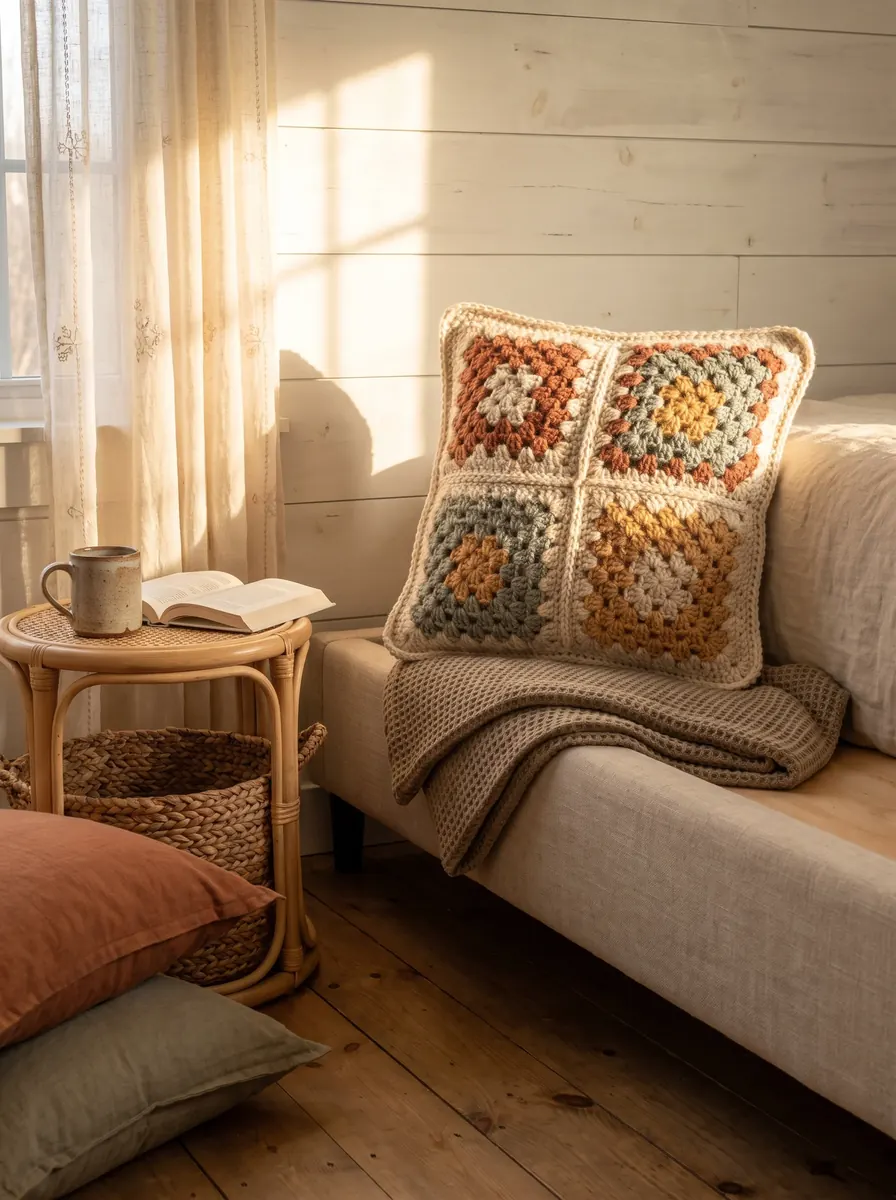
Chain 4 and join into a ring. For round 1, chain 3 (it counts as your first double crochet), work 2 dc into the ring, chain 2, then work (3 dc, ch 2) three more times and slip stitch to the top of the chain 3.
From round 2 on, every corner gets (3 dc, ch 2, 3 dc) in the chain-2 space, and every side space gets 3 dc with a chain 1 between groups. Six rounds give you a square about 6 inches across in worsted cotton.
Sara's Studio Tip: Change color at the end of a round, not the middle. Pull the new color through the last loop of your slip stitch and the join hides inside the corner.
2. A Tasseled Bookmark Made From One Straight Strip

Chain 12 and work one half double crochet into the third chain from the hook and each chain across. Chain 2, turn, and repeat that row until the strip measures 7.5 inches. Count your stitches at the end of every row, because a dropped edge stitch is the most common beginner slip.
For the tassel, wrap your thread 25 times around a 3-inch card. Tie the loops at the top, slide them off, wrap a tight neck just below the tie and cut the bottom loops open. Sew the tassel to one short end and trim it level.
Make three in different colors and tie them with twine for an easy gift for a reader.
3. Round Coasters for Every Mug in the House

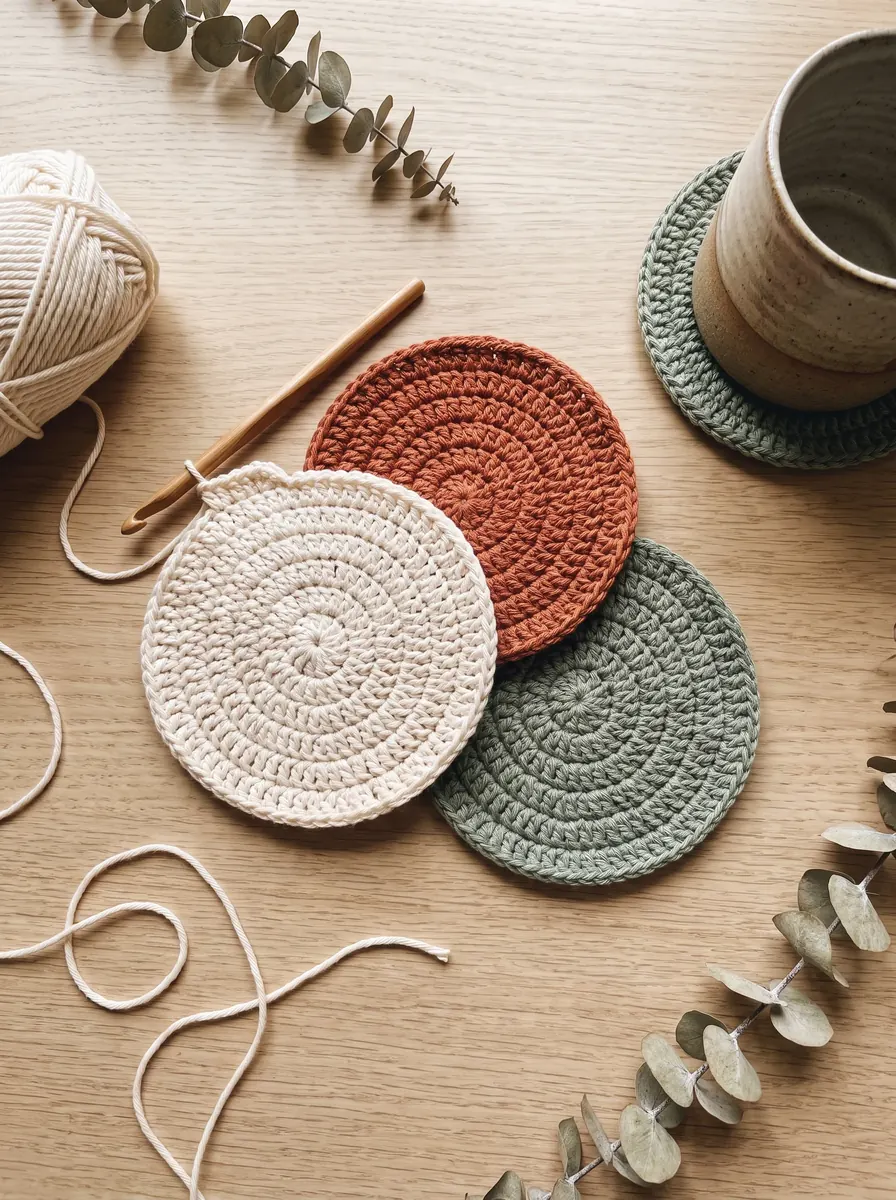
Start with a magic ring, chain 2 and work 12 double crochet into it. In round 2, work 2 dc in every stitch (24). In round 3, alternate 2 dc in one stitch and 1 dc in the next (36). Round 4 adds 1 more plain stitch between increases (48).
That rule of 12 extra stitches per round keeps a double crochet circle flat. If yours ruffles, you have too many stitches. If it cups like a bowl, you have too few or your tension is tight.
Use cotton, not acrylic. Acrylic does not absorb condensation and can soften under a hot mug.
4. A Squishy Amigurumi Heart

Make two bumps first. Each one starts as a magic ring of 6 single crochet, then increases to 12 and 18 stitches, followed by three plain rounds of 18. Fasten off the first bump and leave the second on the hook.
Join them by working 18 sc around the second bump and continuing straight into the first, giving you 36 stitches. Decrease every round from here (30, 24, 18, 12, 6), stuffing firmly before the opening gets small. Close the last 6 stitches and sew the small gap between the bumps.
Sara's Studio Tip: Go down one or two hook sizes from the yarn label for amigurumi. Tight stitches keep the stuffing from showing through.
If this is your first spiral, the stitch and hook basics in our crochet beginner guides are a good place to check your technique first.
5. A Simple Five-Petal Flower Motif

In your center color, work 10 single crochet into a magic ring and join. Switch to the petal color. Work (sc, chain 3, skip 1 stitch) five times and join into the first sc. You now have five chain-3 loops.
Into each loop, work sc, hdc, 5 dc, hdc, sc. Each loop becomes one rounded petal. Fasten off and weave the tail through the back of the center so the ring pulls tight.
Glue one to a hair clip, stitch three onto a plain tote, or keep a jar of them for gift wrapping.
6. A Chunky Twisted Headband

Chain 12. Work half double crochet in the back loop only of each stitch, row after row, until the strip measures 19 inches, or about 2 inches less than the head it is for. The back-loop rows create the stretchy ribbing.
To make the twist, fold each short end in half lengthwise and slide one folded end inside the other so they interlock. Sew through all four layers with a yarn needle, then turn the band so the seam sits on the inside.
7. A Textured Washcloth in Suzette Stitch

The suzette stitch pairs a single crochet and a double crochet in the same stitch, then skips the next one. Chain an even number, about 30 for an 8-inch cloth. Work (sc, dc) into the third chain from the hook, skip 1, and repeat across, ending with a sc in the last chain.
On every following row, chain 1, turn and work (sc, dc) into each single crochet from the row below. Finish with one round of single crochet around all four sides, putting 3 sc into each corner.
Make a stack in calm colors, tie them with ribbon, and add a bar of soap for a spa gift that costs a few dollars.
8. A Button Mug Cozy for Cold Mornings

Chain enough stitches to match the height of your mug's straight section, usually 3 to 3.5 inches. Work rows of half double crochet until the strip reaches from one side of the handle around to the other side.
On the last row, work to the middle stitches, chain 2, skip 2 stitches and finish the row. That gap is your buttonhole. Sew a wooden button on the opposite end, lined up with the hole.
These sell well at craft fairs, and they keep your hand away from a hot ceramic wall.
9. A Little Drawstring Pouch

Chain 11. Work sc into the second chain from the hook and along the chain, put 3 sc into the last chain, then turn your work and continue along the other side of the chain. This gives you a flat oval base. Keep working sc in a continuous spiral without increasing, and the sides rise up.
When the tube is about 4.5 inches tall, work an eyelet round of (dc, chain 1, skip 1). Add two rounds of sc above it. Chain two cords of about 20 inches each and weave one in from each side.
10. A Granny Square Blanket Built One Square a Day

Crochet a square in front of the TV, drop it into a basket, and make another tomorrow. A 50 x 60 inch throw needs 80 six-inch squares, eight across and ten down. A baby blanket of 30 x 36 inches needs 30 squares.
When you have enough, lay them out on the floor and photograph the arrangement before joining. Join with slip stitch through the back loops in cream, then add two rounds of double crochet as a border.
Sara's Studio Tip: Weave in your ends after every square, not at the end. Eighty squares can leave three hundred tails, and no one finishes a blanket after facing that pile.
11. A Mesh Plant Hanger for a Small Pot

Crochet a flat circle in single crochet the size of the pot's base, about 3 inches. Then work rounds of (chain 5, sc into the next stitch), and on later rounds work the sc into each chain-5 loop. Six or seven mesh rounds cover the lower two-thirds of a 4-inch pot.
Gather the top loops into three groups, chain a long cord from each group and tie all three into an overhand knot. Leave a long fringe at the bottom by knotting extra lengths of cord through the base.
Do not use regular yarn here. Thin yarn stretches under the weight of wet soil.
12. Heart and Star Keychains From Scrap Yarn

For the star, make two flat stars. Work 10 sc into a magic ring and join. For each point, chain 4, then working back down the chain work sc, hdc and dc, skip 1 stitch of the ring and slip stitch into the next. Repeat five times.
Hold the two stars together and single crochet around the edges, stuffing lightly before you close the last point. Attach a split key ring with a jump ring through the top point.
For more small makes like these, browse our crochet keychain ideas with 18 shapes to try next.
13. A Bobble Stitch Pillow Cover

Work the front panel in rows. Every right-side row is plain single crochet. On every wrong-side row, alternate one bobble and one single crochet. The bobbles push away from you, so they pop out on the right side.
The back panel is plain single crochet at the same size. Hold both panels together and single crochet around three sides, slide in the insert, then close the fourth side.
14. An Open Mesh Scarf

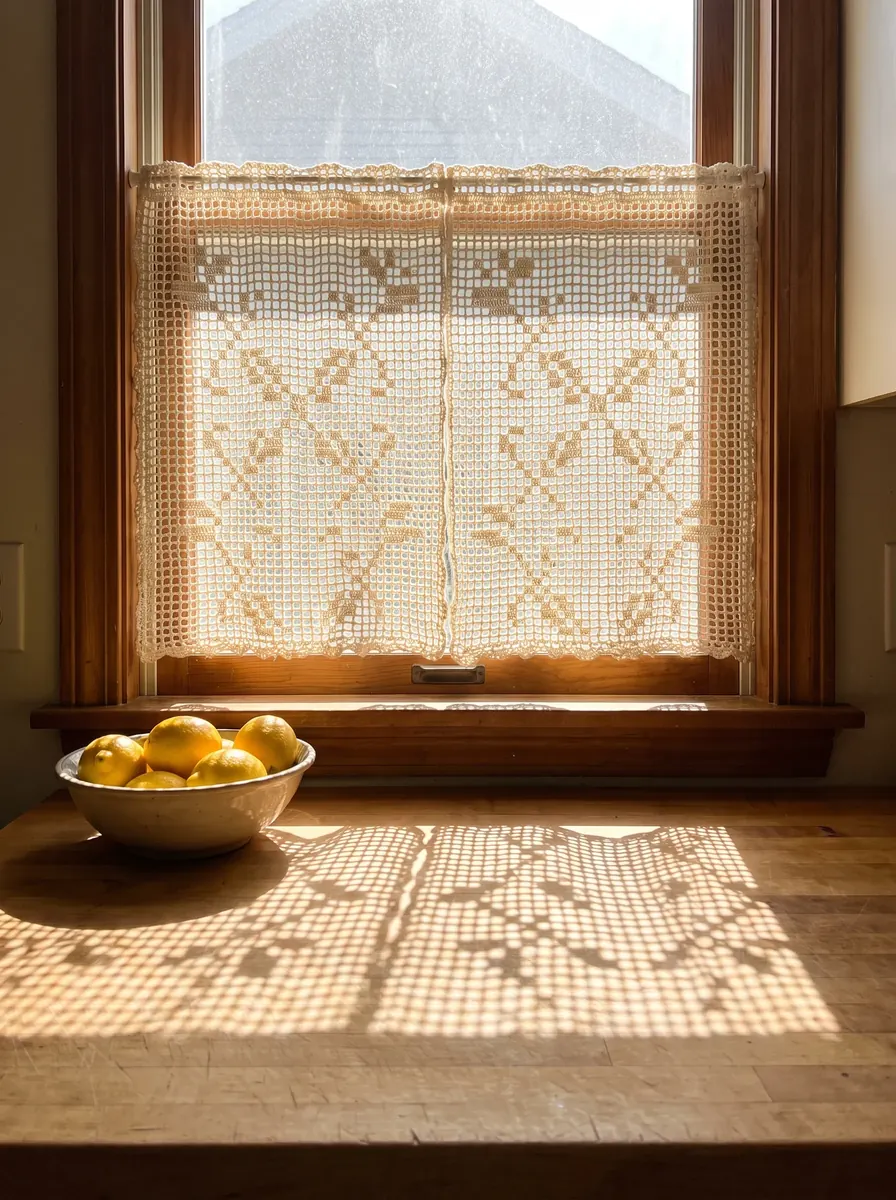
This one uses filet mesh. Chain an odd number, about 29 for a 7-inch width. Work a dc into the sixth chain from the hook, then (chain 1, skip 1, dc in next) across. On every following row, chain 4, turn and work (dc into the next dc, chain 1) across.
The open spaces mean the scarf grows twice as fast as a solid fabric. Stop at 70 inches, or when you run out of the third ball, and weave in your ends along the edge.
15. A Circle and Triangle Garland

For each circle, work three rounds of the coaster pattern. For each triangle, chain 16 and work rows of single crochet, skipping the first and last stitch of every row until 1 stitch remains.
When you have 12 to 16 shapes, chain about 20 stitches for a hanging tail. Then single crochet across the top edge of each shape in turn, with 10 chains between shapes. Finish with another 20-chain tail.
Yarn Weights and Hook Sizes for Your First Projects
Most of the confusion in a first yarn shop trip comes from yarn weights. The number on the label tells you how thick the strand is, and the label also suggests a hook size.
Sport and DK (#2 and #3): Thin enough for bookmarks, keychains and amigurumi. Pair with a 2.75 to 4 mm hook. These are harder to see while learning, so save them for your second or third project.
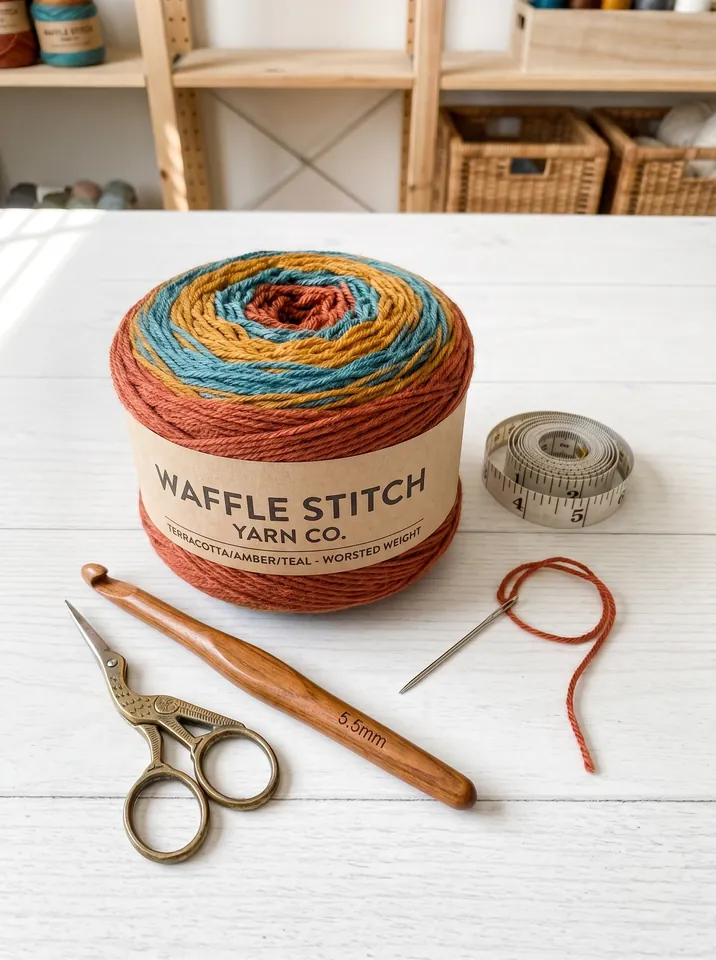
Worsted (#4): The best first yarn. It is thick enough to see each stitch and works with a 4.5 to 5.5 mm hook. Most projects on this list use it.
Bulky and super bulky (#5 and #6): Very fast and forgiving, with 8 to 12 mm hooks. They suit headbands, pillows and quick gifts, but the thick strand can tire your hands on long sessions.
Start with a pale color. Cream, sage and mustard show every stitch, while black and navy hide them, and seeing your stitches is half of learning to count them.
Common Beginner Mistakes and Quick Fixes
Edges that slant or shrink: You are skipping the last stitch or adding one at the start of a row. Put a stitch marker in the first and last stitch of every row until counting becomes automatic.
Circles that ruffle or cup: Ruffling means too many increases; cupping means too few. Recount and follow the rule of 6 increases per round for single crochet and 12 for double crochet.
Tight, hard fabric: Your working loop is too small. Pull each loop up to the full height of the hook's throat, or move up half a hook size.
Holes beside the turning chain: Many beginners count the turning chain as a stitch and then also work into the first stitch. Choose one method and use it on every row.
Frequently Asked Questions
What is the easiest crochet project for a complete beginner? A straight bookmark or a washcloth is the easiest first project. Both are flat rectangles worked in one stitch, so you only need to learn the chain, the stitch itself and how to turn at the end of a row.
What yarn should a beginner use for easy crochet projects? Use a smooth, light-colored worsted weight cotton or cotton blend with a 4.5 to 5 mm hook. Smooth yarn does not split, and a pale color lets you see each stitch clearly while you learn to count.
How long does it take to learn crochet well enough to finish a project? Most people can finish a coaster or bookmark within their first two or three sessions. Rounds, shaping and amigurumi usually feel comfortable after two to four weeks of short daily practice.
Should a beginner start with granny squares or rows? Start with rows, such as a bookmark or washcloth, to learn even tension. Move to a granny square once you can work a full row of double crochet without losing count.
What size crochet hook is best for a beginner? A 5 mm (US H-8) hook is the most useful first hook. It matches worsted yarn, the most common beginner weight, and it is large enough to see the loops easily.
Pick the project that caught your eye first, clear one afternoon and finish it. Every one of these easy crochet projects for beginners builds a skill you will use again, and the confidence from a finished piece is what brings you back to the hook tomorrow.
Save These Ideas for Later
Pin this list to your crochet board so you can come back to it when you are ready to pick your next project.
Save on PinterestKeep reading